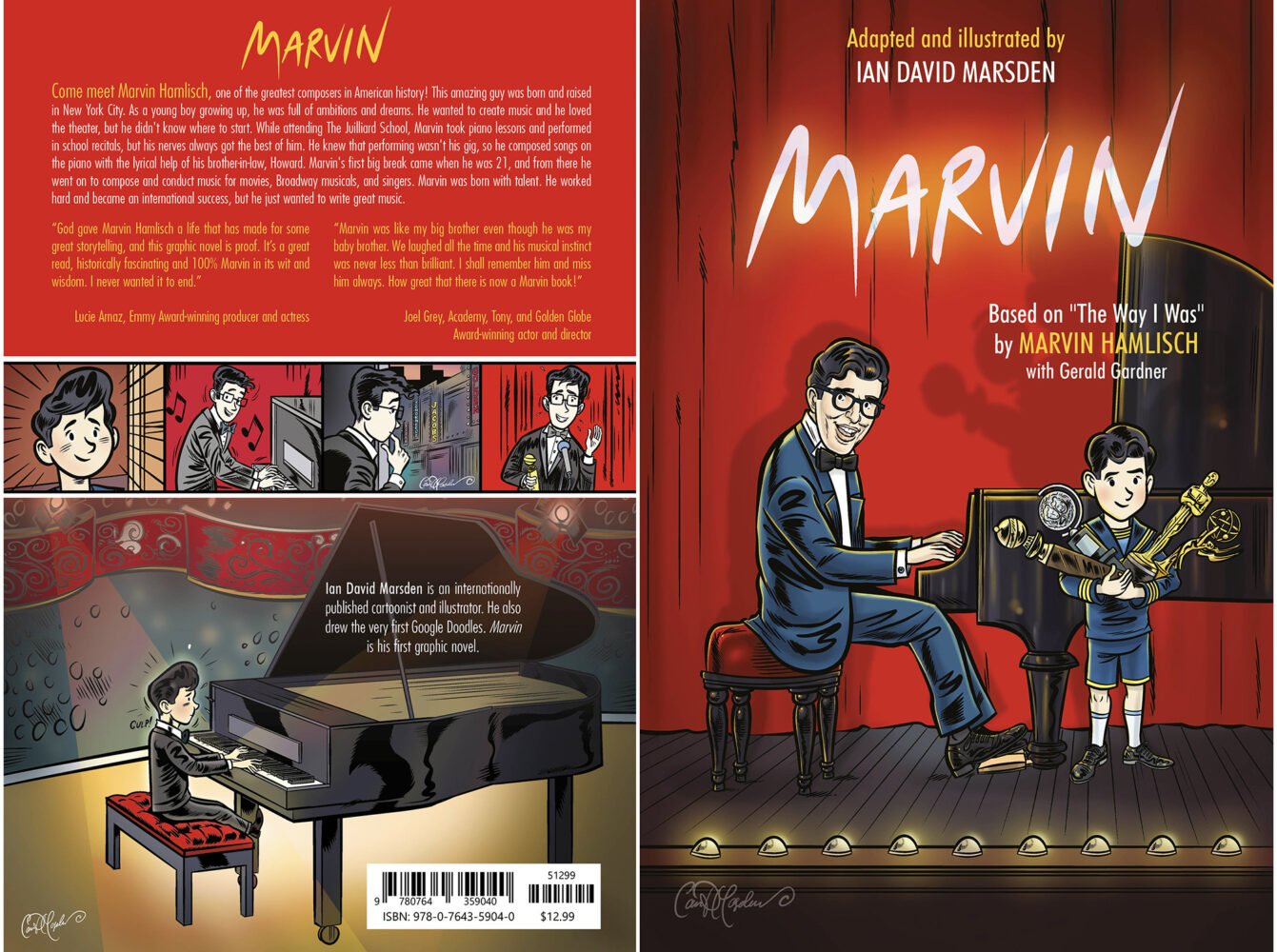
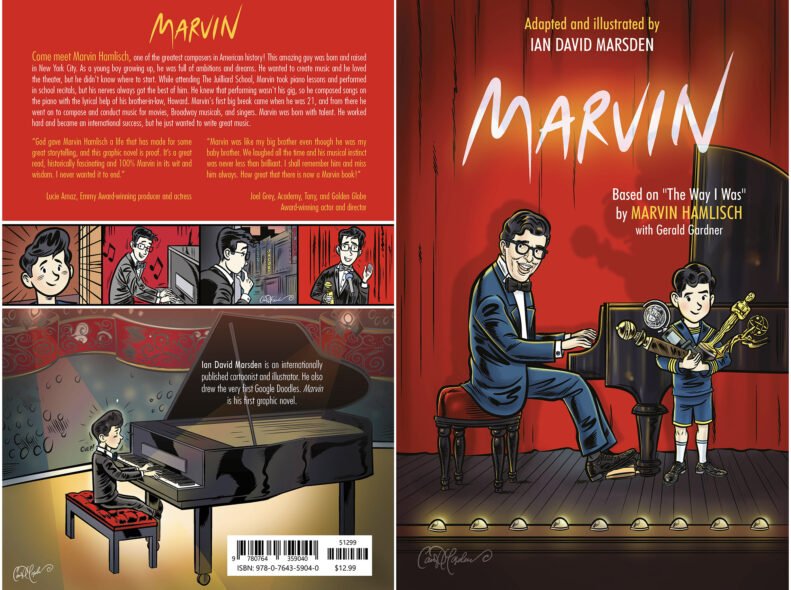
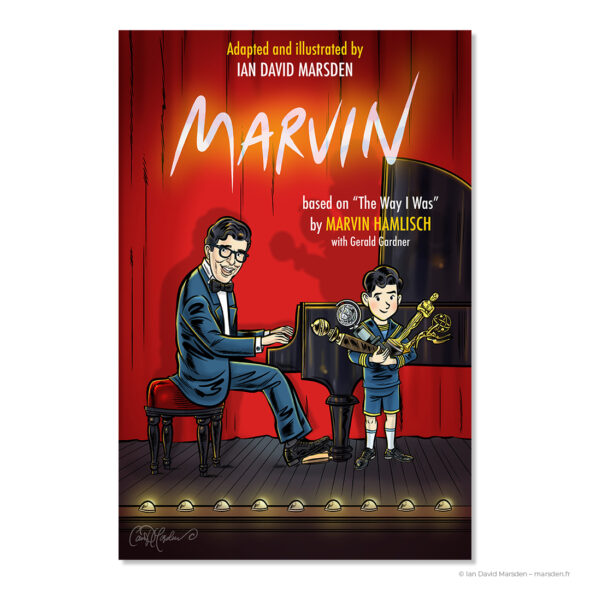
Front and back covers of MARVIN, published by Schiffer Publishing Ltd., with endorsement quotes from Lucie Arnaz and Joel Grey.
Before the Awards
A graphic novel about Marvin Hamlisch — before the Oscars, Tonys and Broadway legend
Marvin Hamlisch later became one of only two people in history, alongside Richard Rodgers, to achieve PEGOT status: winning a Pulitzer Prize, Emmy, Grammy, Oscar and Tony. His credits would eventually include A Chorus Line, The Way We Were, The Sting, Nobody Does It Better, major film scores, Broadway musicals and a long career as a conductor and musical director.
MARVIN, however, begins earlier. The book is interested in the making of Marvin Hamlisch before the public triumphs become inevitable in retrospect. It follows the son of Viennese Jewish immigrants, a gifted child admitted to Juilliard at the age of six, a boy whose musical ability was real and obvious but whose confidence was far less dependable.
Hamlisch’s autobiography is often very funny, but it is also candid about stage fright, self-doubt, embarrassment, family pressure and the strange early bargain between talent and expectation. That combination made the story unusually well suited to comics. The young Marvin is brilliant, observant, theatrical, often terrified, and very funny about all of it after the fact. One could ask for less generous material. I did not.
The Adaptation
Adapted from The Way I Was — written as a graphic novel, not merely illustrated
The source text for MARVIN was Marvin Hamlisch’s autobiography The Way I Was, written with Gerald Gardner. My task was not simply to illustrate that memoir, but to adapt it as a graphic novel: selecting, restructuring and scripting the material for a 64-page work of comic art and sequential storytelling.
I approached the material much as one would approach a screenplay adaptation: identifying the dramatic spine, choosing which scenes carry the story, deciding where a page turn matters, compressing anecdotes into sequences and finding visual ways to preserve Hamlisch’s voice without burying the artwork under narration.
I wrote the graphic novel script, structured the scenes, designed the pages, developed the visual likenesses and character acting, drew every panel and carried the book through as a complete work of sequential art. It is therefore not simply an illustrated edition of an existing memoir, but a graphic novel adaptation with its own pacing, panel rhythm and visual point of view.
The project was represented by Anna Olswanger of Olswanger Literary LLC in New York. Her editorial intelligence and publishing experience were important throughout the development of the book.
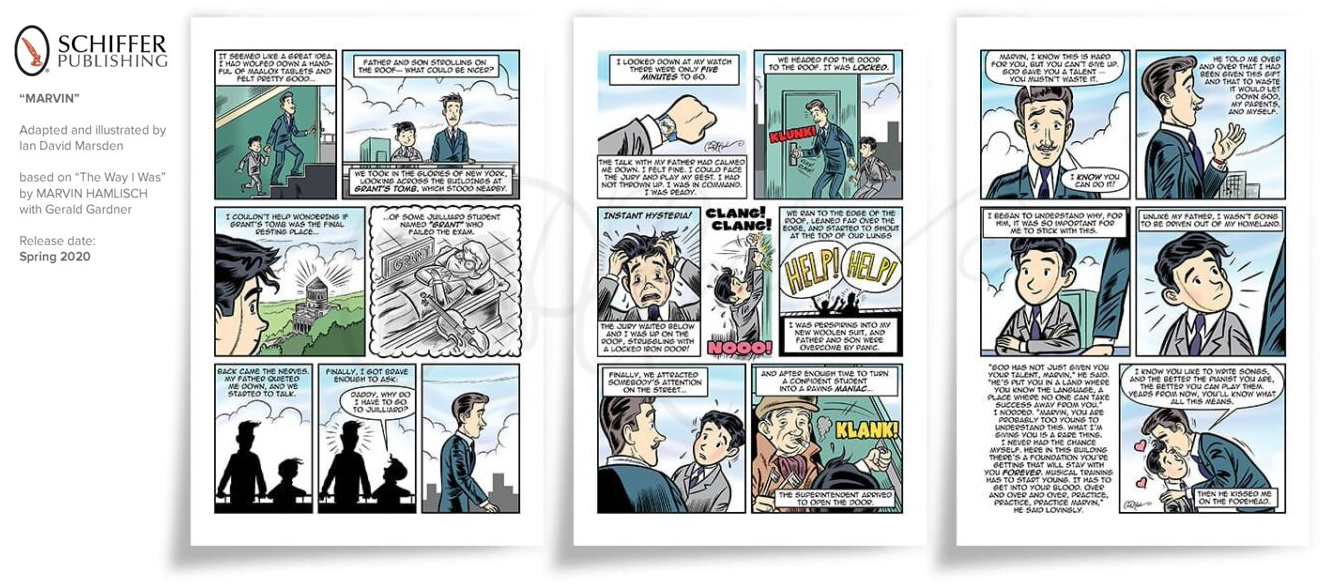
Three pages from MARVIN, adapted, written and illustrated by Ian David Marsden, including a key rooftop conversation between young Marvin Hamlisch and his father.
Family History
The family history behind the composer
One of the parts of Hamlisch’s story that mattered most to me while adapting the book was the history that precedes his birth. His parents, Max and Lilly Hamlisch, were Austrian Jews who escaped the tightening grip of Nazism and made their way to the United States.
The book returns to their story in extended flashbacks: the pressure closing in around them in Vienna, Max’s precarious escape route to Switzerland, work in Liechtenstein, Lilly’s desperate preparations to leave, and the improvised courage required simply to get away.
This material gives MARVIN an emotional foundation that is easy to overlook if one thinks of Hamlisch only in terms of awards, Broadway and Hollywood. His life begins inside a family shaped by escape, displacement and reinvention.
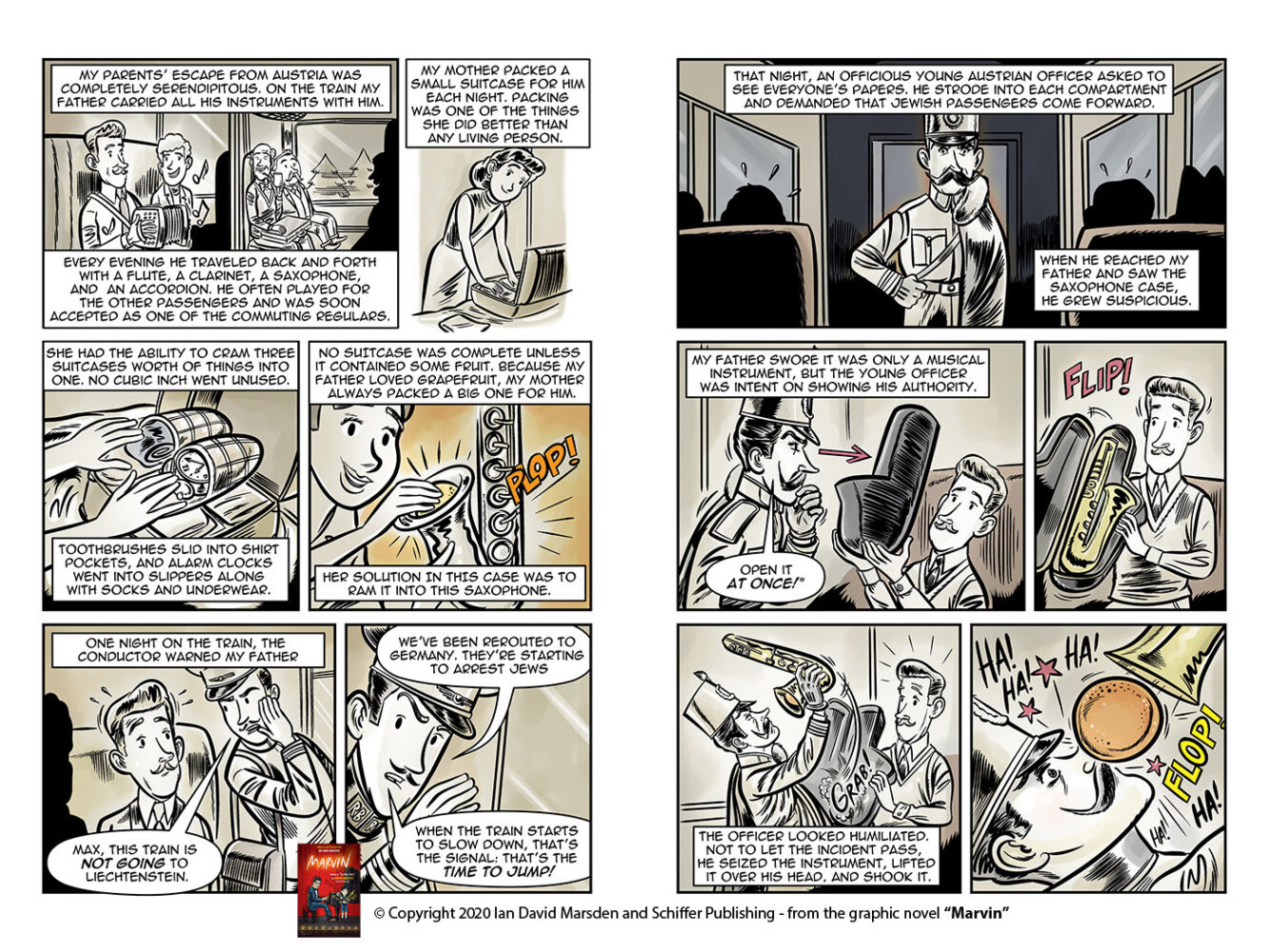
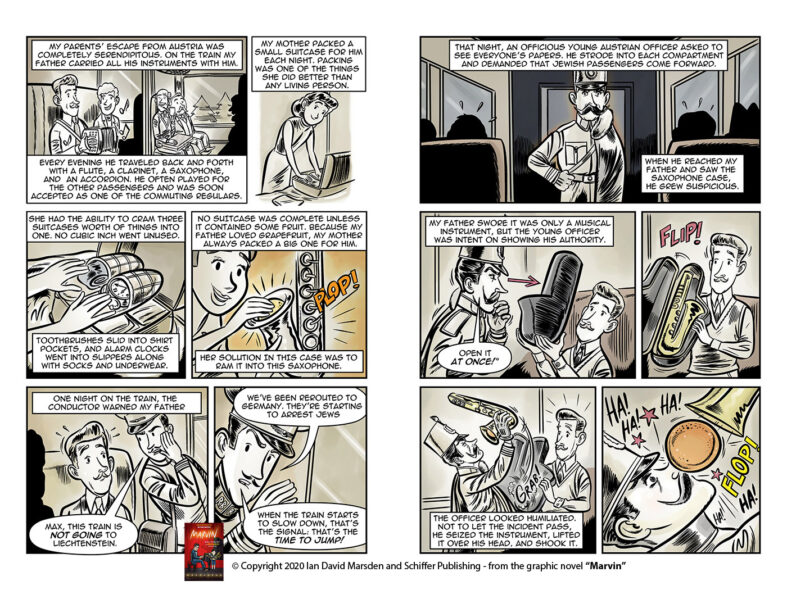
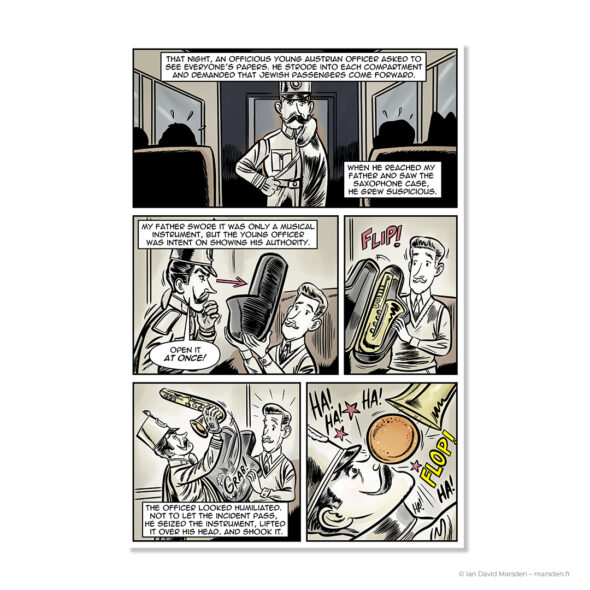
A tense pre-Marvin family-history spread: Max and Lilly Hamlisch leave Austria, and a suspicious officer on the train finds not contraband but a saxophone — to his own embarrassment.
Visually, I treated these sequences differently from the more brightly coloured New York and show-business episodes. The earlier family-history pages use a quieter, more restrained palette, allowing the tone to shift without changing the essential graphic language of the book.
Childhood
Juilliard at six, schoolroom calamities and a child prodigy who was still a child
Marvin Hamlisch entered Juilliard at an age when most children are still negotiating shoelaces and the moral consequences of not sharing crayons. In the book, that extraordinary early training sits beside the ordinary and less dignified business of being a young boy in New York: school, hunger, stickball, television, disobedience, embarrassment, teachers who loom larger than life, and a musical education pursued with seriousness while childhood continues making its own demands.
These scenes were essential to the adaptation. They prevent the book from becoming a tidy recital of achievements. Marvin is not presented as a miniature monument. He is a child with talent, nerves, appetite, curiosity, strong feelings and a tendency to turn an inconvenience into a full dramatic situation.
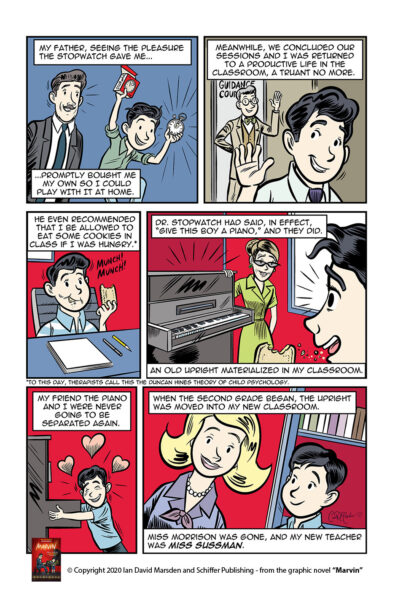
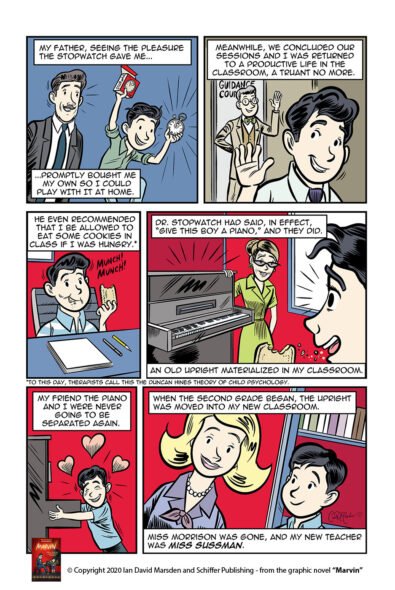
A page from MARVIN in which the famous stopwatch solution works, Marvin returns to school, cookies become medically defensible, and a classroom piano changes everything.
Early Show Business
Liza Minnelli, Judy Garland, Barbra Streisand and the first improbable turns of a career
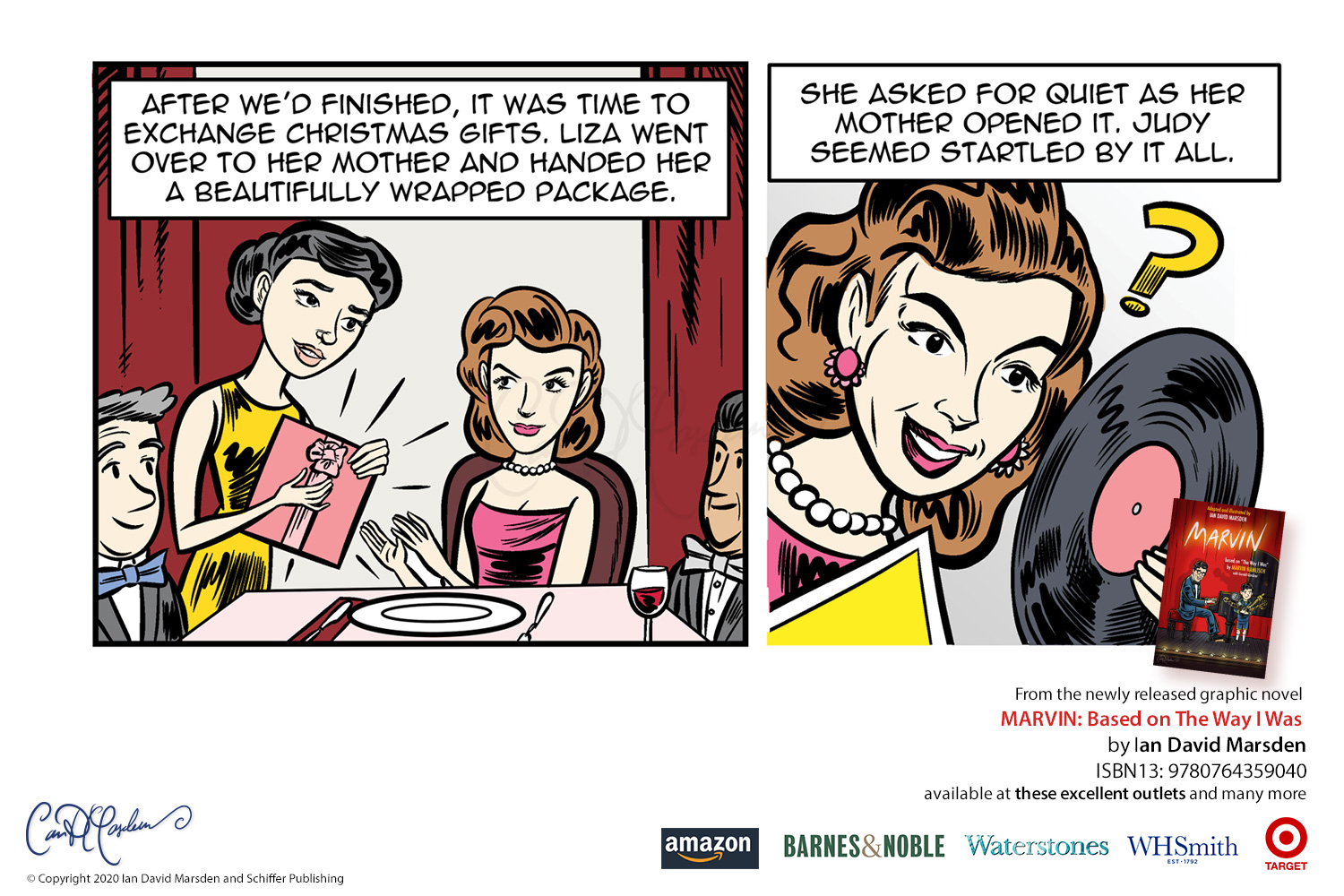
As Hamlisch grows older, MARVIN begins to acquire a cast list that would look suspiciously overqualified if it had been invented. While still very young, he helped create a Christmas recording for Liza Minnelli to give to her mother, Judy Garland. He later worked as a rehearsal pianist for Barbra Streisand during Funny Girl. These are not retrospective celebrity ornaments added for sparkle; they are simply part of what happened astonishingly early in Hamlisch’s life.
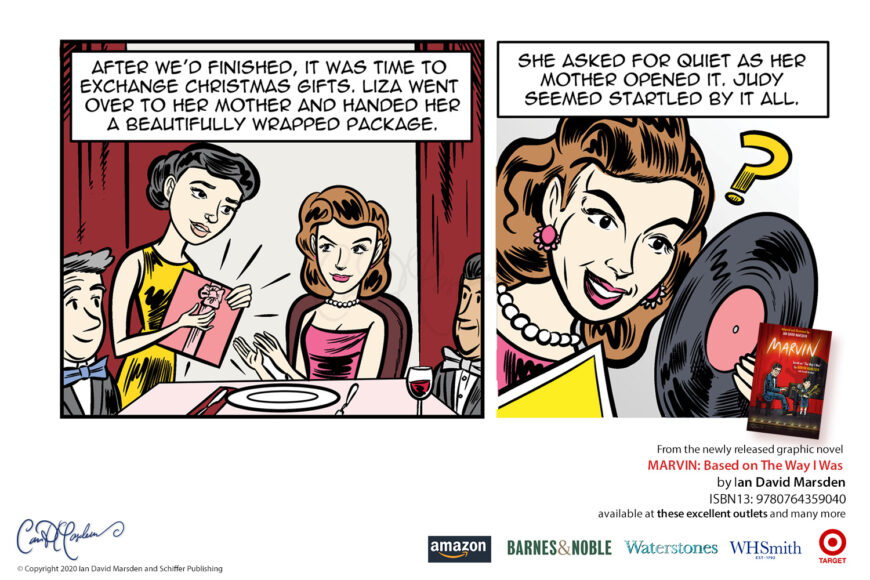
A holiday scene from MARVIN: young Liza Minnelli gives her mother Judy Garland a carefully wrapped Christmas gift, and Judy is not quite prepared for what she finds inside.
From Parties to Film Scoring
Sam Spiegel, Quincy Jones and The Swimmer
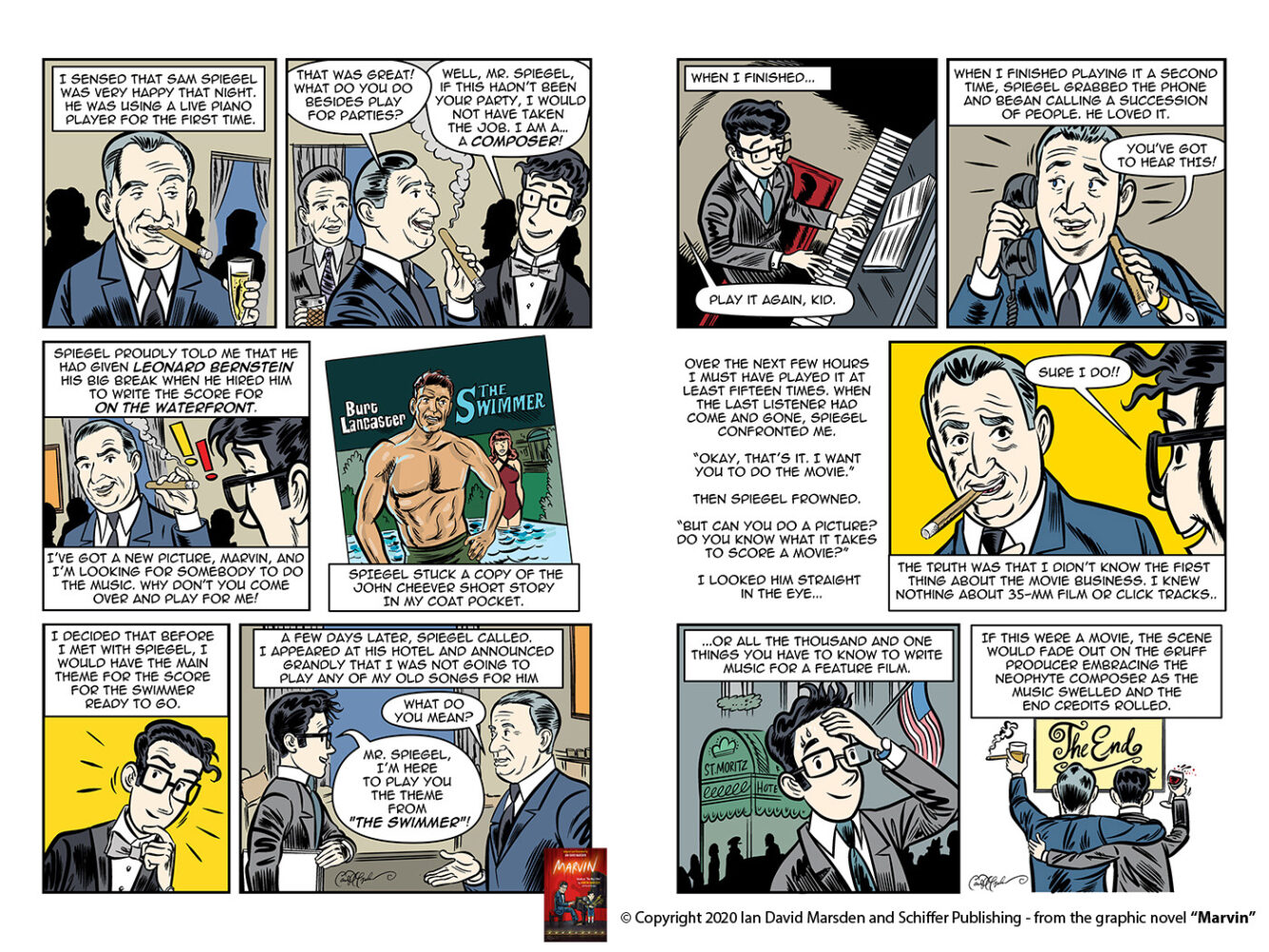
The graphic novel also includes the more eccentric side roads of his early career: being summoned to play piano at a party hosted by producer Sam Spiegel; observing Bobby Kennedy among the guests; seeking practical advice from Quincy Jones over a job offer that looked distinctly underpriced; and then stepping into film scoring with The Swimmer, the 1968 Burt Lancaster film that became Hamlisch’s first feature score.
These scenes allow the reader to watch Hamlisch approaching the threshold of a professional life while still not quite believing the door has opened. They also make the story particularly rich for readers interested in film music, Broadway, musical theatre, Hollywood history and the apprenticeship years of a major composer.
Music & Sequential Storytelling
A graphic novel about music, timing and learning how scenes work
Comics cannot reproduce music directly, which is both a difficulty and an invitation. In adapting Hamlisch’s life, I was especially interested in the practical work around music: counting seconds, shaping emotional cues, arguing with time, watching pictures while imagining what sound should do, and trying to understand how a few bars can alter the temperature of an entire scene.
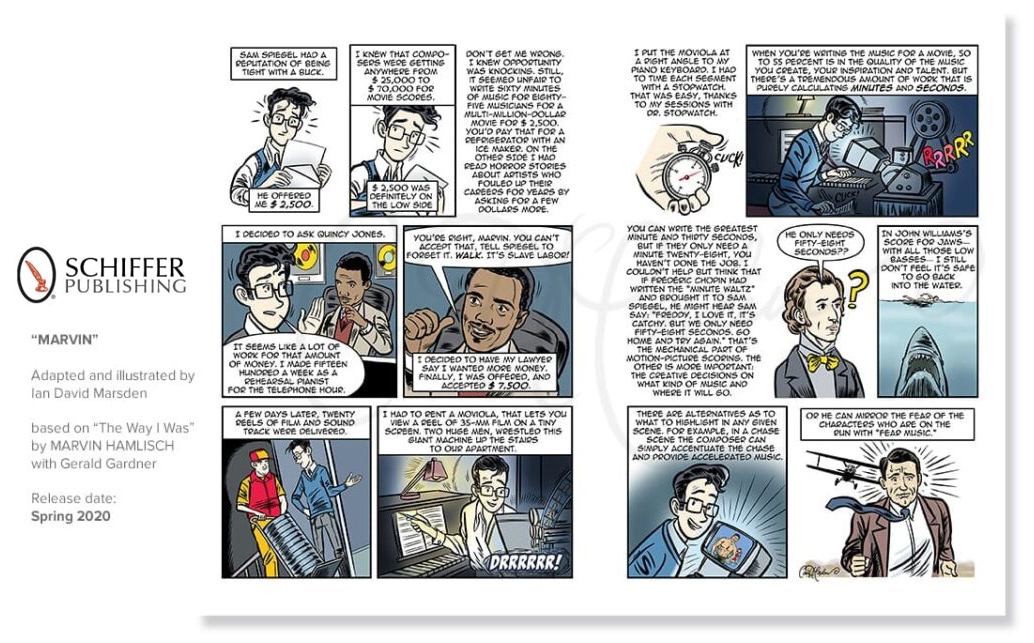
The book’s sequences around The Swimmer gave me a way to show this visually. Hamlisch is not simply “becoming successful”; he is learning a craft. He is timing film, looking at movement, asking how fear works in music, and discovering that composition for picture is a form of storytelling with its own exacting logic. The page had to make the reader feel the thinking process, not merely report that it occurred.
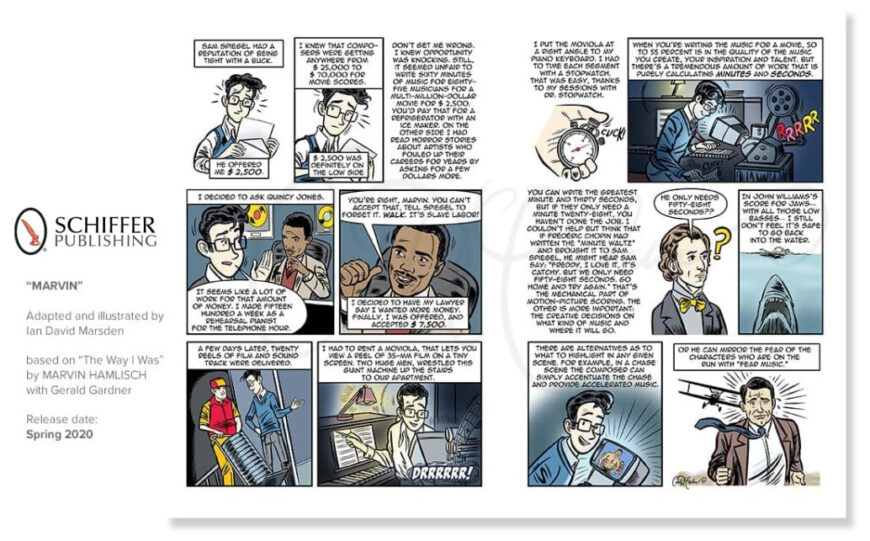
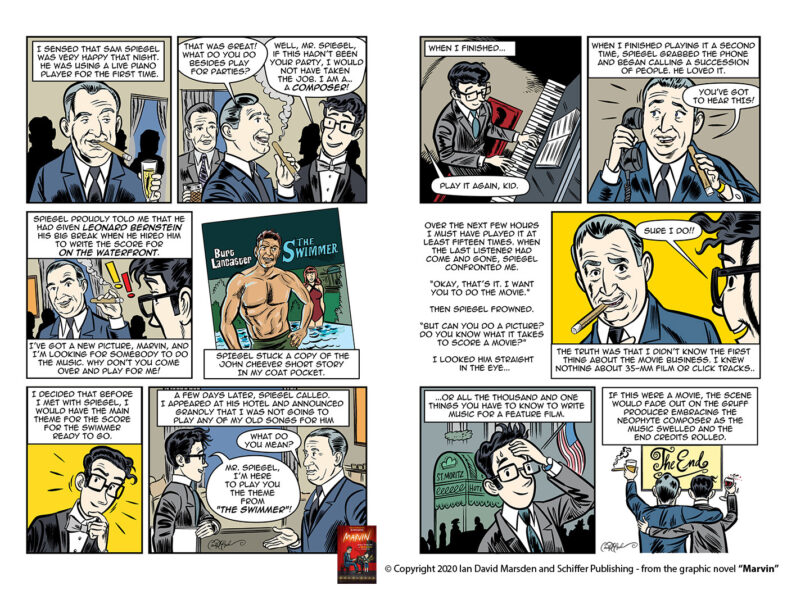
A sequence from MARVIN about the unexpected chain of events that led producer Sam Spiegel to hire Marvin Hamlisch for his first feature-film score, The Swimmer.
Selected Pages
The practical terror of a first film-scoring assignment
Each image belongs to the published MARVIN project and reflects my role in adapting, scripting, drawing and shaping the book as a complete graphic narrative.
Interior pages from MARVIN about the practical terror of an early film-scoring assignment: not enough money, too little time, and no obvious way to write fifty-eight seconds of fear.
Recognition & Reviews
Awards, reviews and one memorable critique
Purple Dragonfly Book Awards
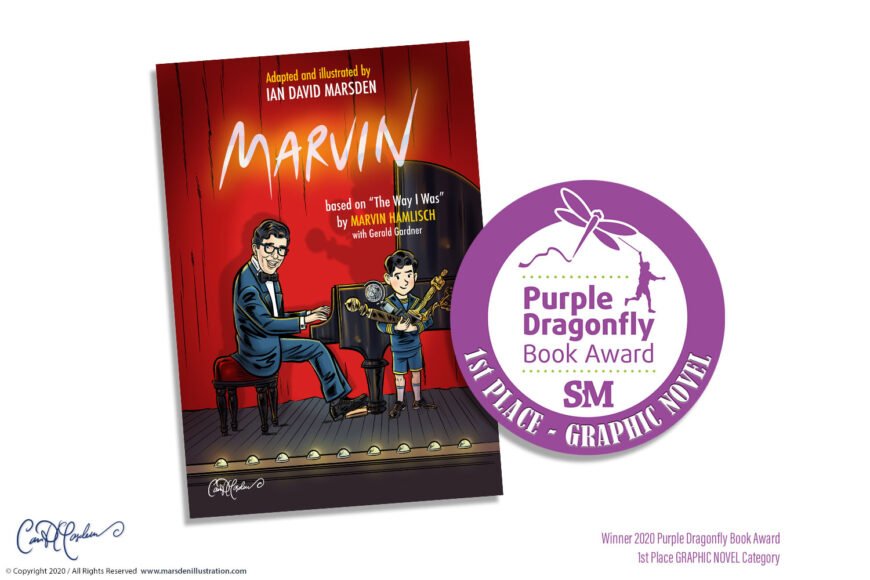
MARVIN received 1st Place in the Graphic Novel category of the 2020 Purple Dragonfly Book Awards.
The Jewish Book Council reviewed the book in 2020, drawing attention to the family-history strand, the Hollywood and musical-theatre material and the “celebrity cameos and behind-the-scenes looks at Hollywood.”
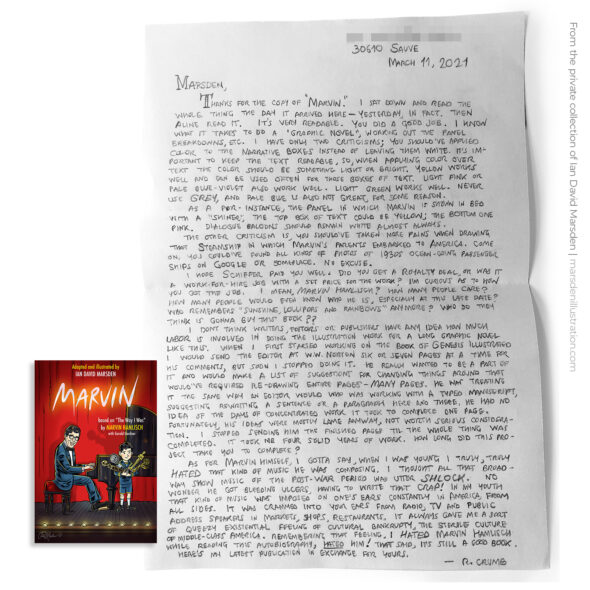
During the pandemic I sent Robert Crumb a copy. He replied with a full-page handwritten critique covering colour, research, steamships and a magnificently unsparing dislike of Marvin Hamlisch’s music. His final verdict was: “That said, it’s still a good book.”
MARVIN remains one of the projects I am proudest to have completed. It was my first published graphic novel, but it also drew on decades of work that had come before it: cartooning, editorial illustration, character acting, dialogue compression, page rhythm, book design and the slightly unnatural pleasure of deciding exactly how much can happen in one panel before the reader revolts.
More importantly, it gave me the chance to adapt a genuinely remarkable life. Marvin Hamlisch’s story contains major cultural history, but also family memory, private insecurity, comic timing and the practical labour behind artistic achievement. That combination is what made it worth turning into a graphic novel.
Working on a story that needs to become a visual narrative?
For graphic novel adaptation, illustrated biography, comics, book illustration or other long-form visual narrative projects, send me a brief outline of the material and what stage the project has reached.
Selected pages, artwork & publication material from MARVIN
The gallery below brings together a wider selection of pages, excerpts, promotional visuals and publication material from the graphic novel. It includes family-history flashbacks, childhood and Juilliard scenes, film-scoring passages, moments involving Liza Minnelli, Judy Garland, Quincy Jones, Sam Spiegel and Bobby Kennedy, as well as interior book photographs, cover presentations and award material.
Marvin, based on The Way I Was by Marvin Hamlisch – Graphic Novel, Adapted and Illustrated by Ian David Marsden
MARVIN Graphic Novel Front and Back Covers — Schiffer Publishing Edition
Front and back covers of MARVIN, published by Schiffer Publishing Ltd., with endorsement quotes from Lucie Arnaz and Joel Grey.
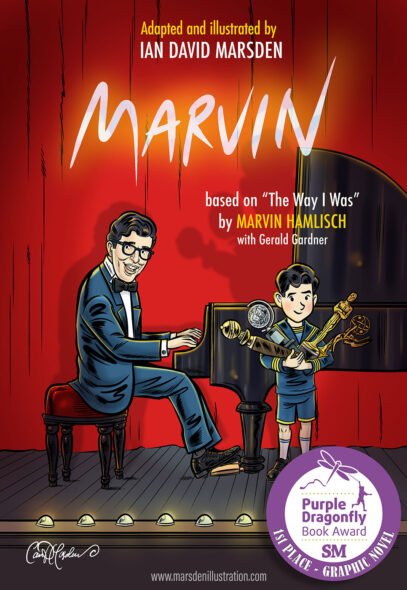
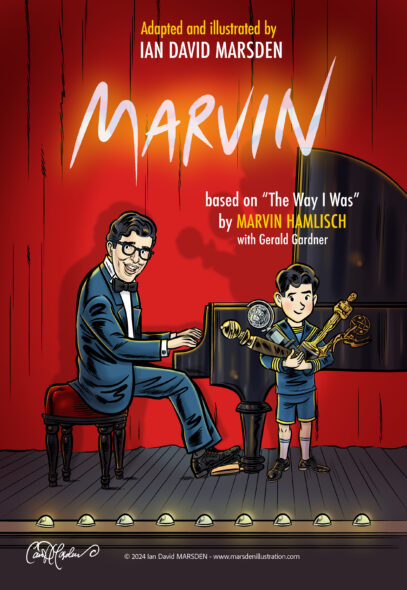
MARVIN Graphic Novel Cover — Purple Dragonfly Book Award Winner
Cover of MARVIN, the graphic novel adapted, written and illustrated by Ian David Marsden, winner of 1st Place in the 2020 Purple Dragonfly Book Awards Graphic Novel category.
MARVIN Promotional Comic — Young Liza Minnelli Gives Judy Garland a Christmas Gift
A holiday scene from MARVIN: young Liza Minnelli gives her mother Judy Garland a carefully wrapped Christmas gift, and Judy is not quite prepared for what she finds inside.
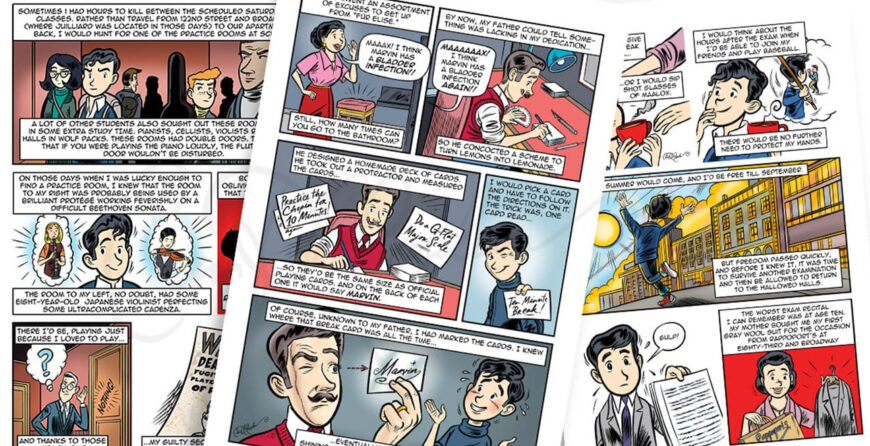
MARVIN Interior Comic Pages — Childhood, Music Lessons and Family Pressure
Interior comic pages from MARVIN, showing the young Marvin Hamlisch moving between music practice, school life and the affectionate pressure of a very ambitious household.
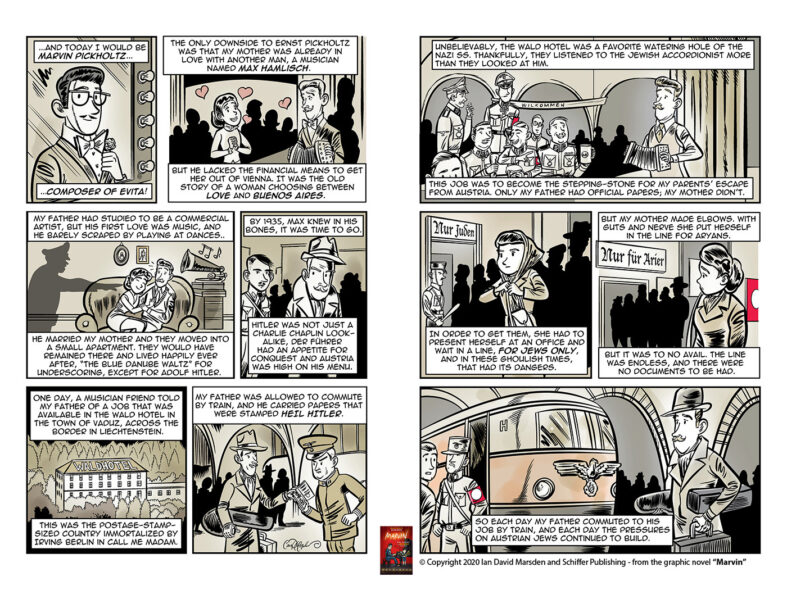
MARVIN Graphic Novel Flashback — Max and Lilly Hamlisch’s Escape from Nazi Austria
A sepia-toned flashback from MARVIN recounting how Max and Lilly Hamlisch, Marvin’s parents, navigated mounting danger in Austria before escaping toward safety.
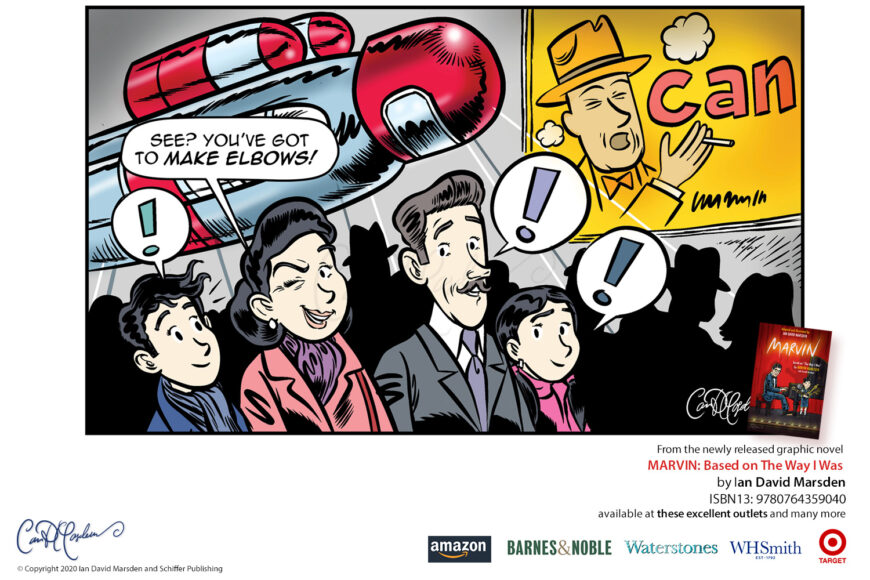
MARVIN Graphic Novel Spread — Lilly Schachter, Jewish Identity and the Macy’s Thanksgiving Day Parade
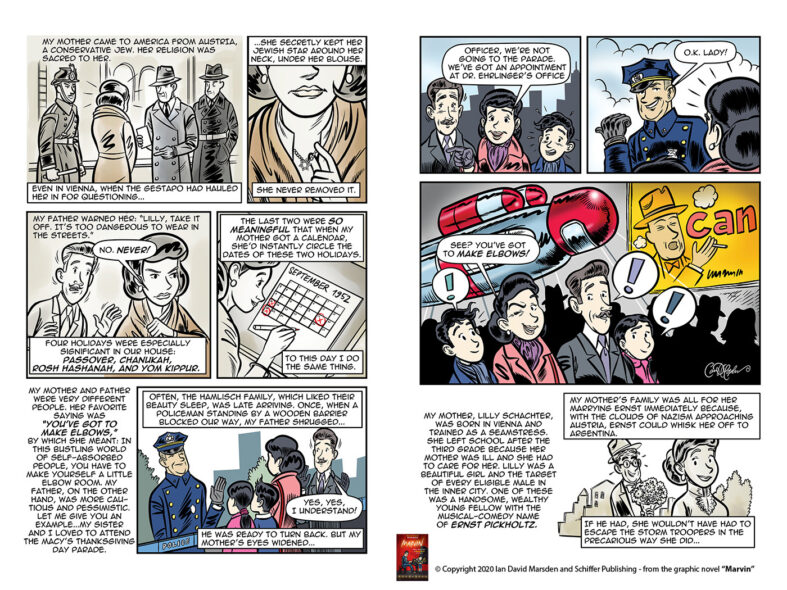
A family-history spread from MARVIN: Lilly Schachter keeps her Jewish identity close in Vienna, later becomes a New Yorker, and learns during the Macy’s Thanksgiving Day Parade that American crowds require “elbows.”
MARVIN Graphic Novel Promotional Image — Ian David Marsden with the Published Book
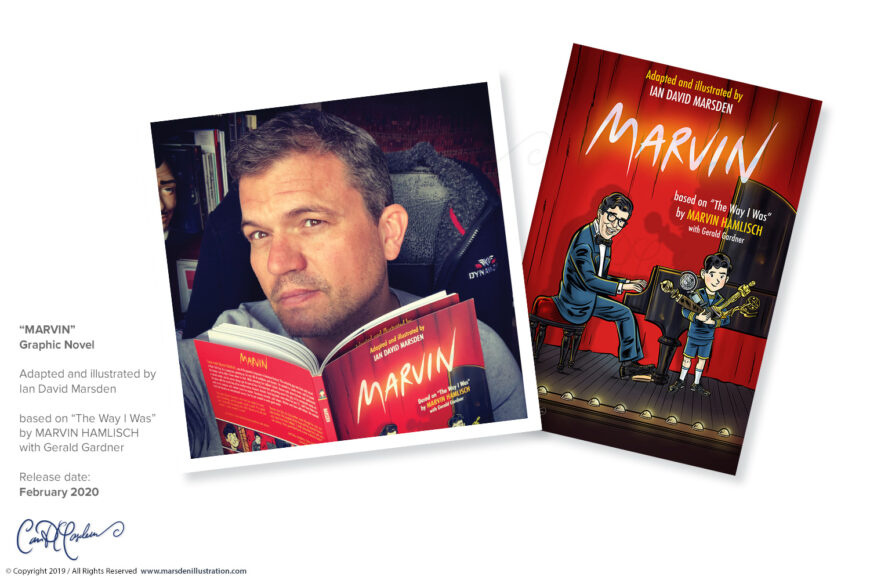
Promotional image for MARVIN, showing Ian David Marsden with the published graphic novel and the finished cover artwork for the 2020 Schiffer Publishing edition.
MARVIN Sample Pages — Early Film Scoring, Quincy Jones and Fear Music
Interior pages from MARVIN about the practical terror of an early film-scoring assignment: not enough money, too little time, and no obvious way to write fifty-eight seconds of fear.
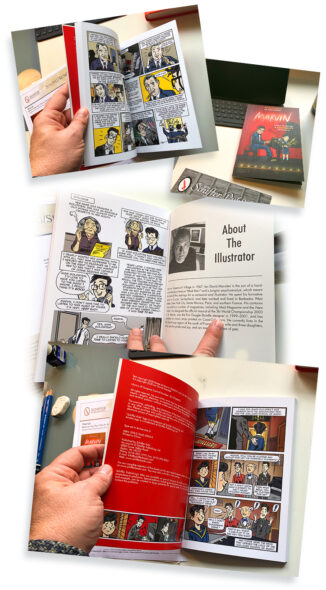
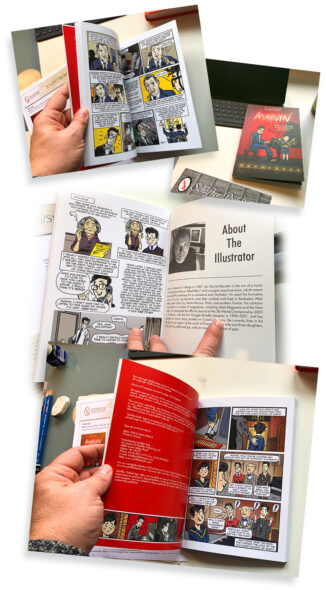
MARVIN Graphic Novel — Printed Interior Pages, Epilogue and About the Illustrator Section
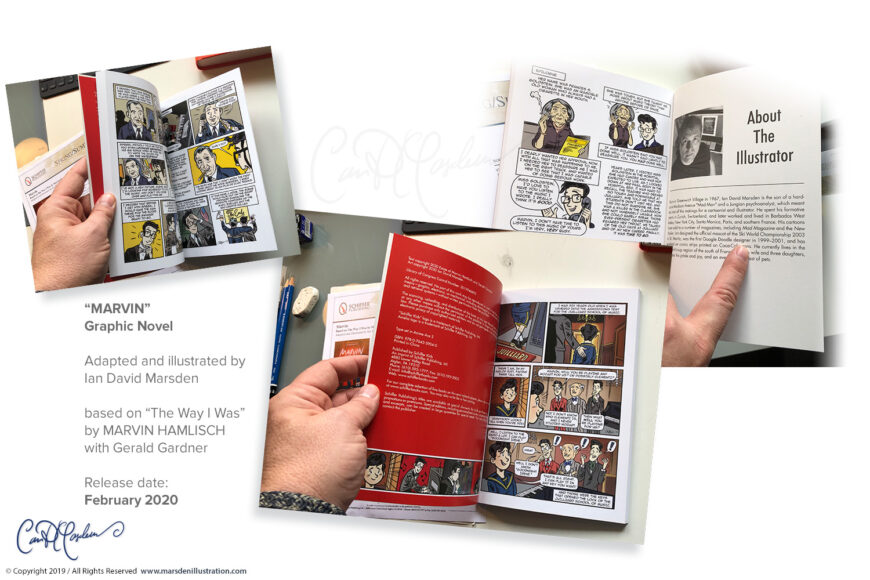
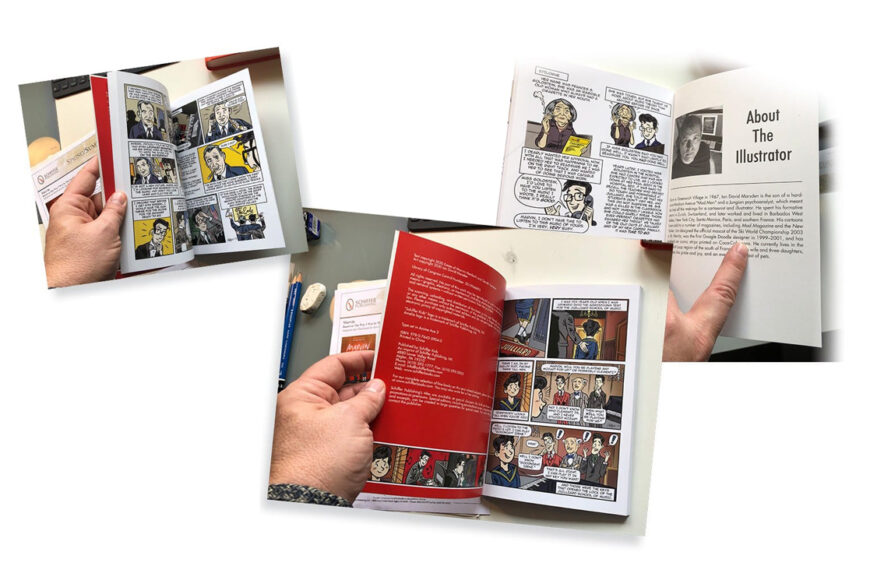
The printed MARVIN graphic novel, showing selected interior pages, the closing epilogue on Frances S. Goldstein and the book’s “About the Illustrator” section.
The published edition of MARVIN, photographed with its cover and several interior spreads from the Schiffer Publishing graphic novel.
Robert Crumb’s 2021 Critique Letter on “Marvin” – Ian David Marsden Archive
Robert Crumb’s full-page handwritten critique of Ian David Marsden’s graphic novel Marvin: Based on The Way I Was. Sent from Sauve in 2021, the letter offers detailed artistic feedback as well as humorous commentary on music, color choices, and steamship research.
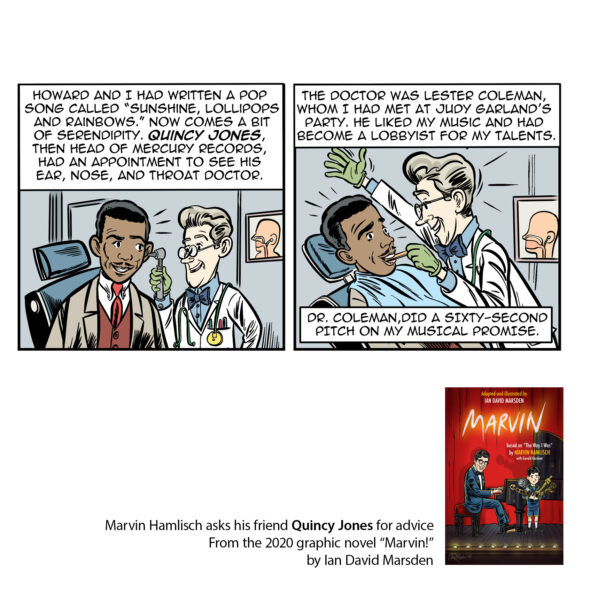
MARVIN Promotional Comic — Quincy Jones, Dr. Lester Coleman and a Lucky Introduction
From a promotional MARVIN sequence: Quincy Jones visits Dr. Lester Coleman, who uses the appointment to make a sixty-second pitch for Marvin Hamlisch.
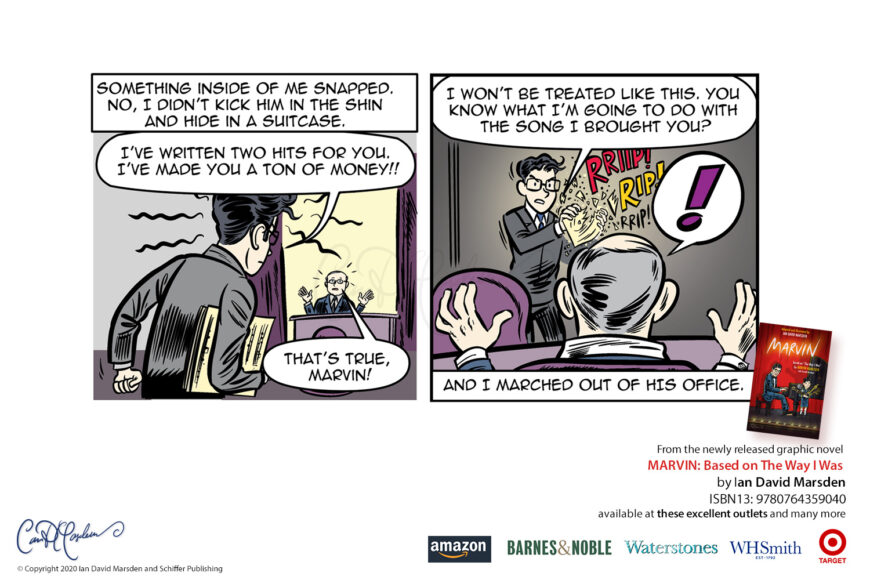
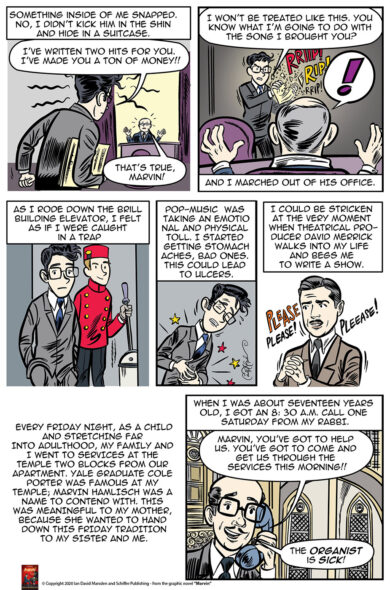
MARVIN Promotional Comic — Marvin Hamlisch Tears Up His Song in a Producer’s Office
A young Marvin Hamlisch reaches the limit of polite humiliation, tears up the song he has brought to a producer, and walks out. The emotional consequences arrive a few panels later.
MARVIN Graphic Novel Pages — Sam Spiegel, The Swimmer and Marvin Hamlisch’s First Film Score
A sequence from MARVIN about the unexpected chain of events that led producer Sam Spiegel to hire Marvin Hamlisch for his first feature-film score, The Swimmer.
MARVIN Graphic Novel Page — Stopwatch Therapy, School Return and the Classroom Piano
A page from MARVIN in which the famous stopwatch solution works, Marvin returns to school, cookies become medically defensible, and a classroom piano changes everything.
MARVIN Graphic Novel Spread — The Hamlisch Family Escape from Austria with a Saxophone
A tense pre-Marvin family-history spread: Max and Lilly Hamlisch leave Austria, and a suspicious officer on the train finds not contraband but a saxophone — to his own embarrassment.
MARVIN Graphic Novel Page — Young Marvin Hamlisch Performs with a Black Eye
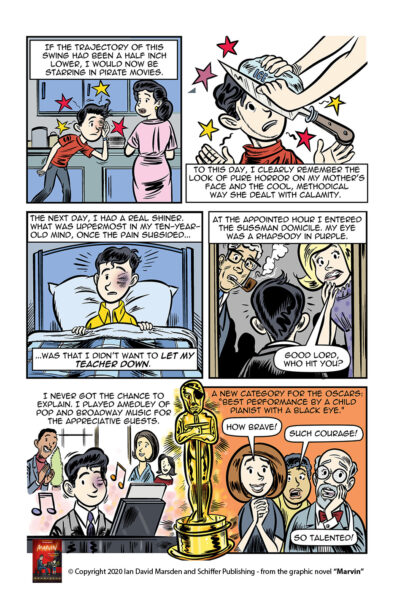
A comic page from MARVIN recounting one of Hamlisch’s childhood misadventures: a baseball mishap, a spectacular black eye and, naturally, a piano performance the next day.
MARVIN Graphic Novel Page — Lilly Hamlisch Hides Cash During the Flight from Vienna
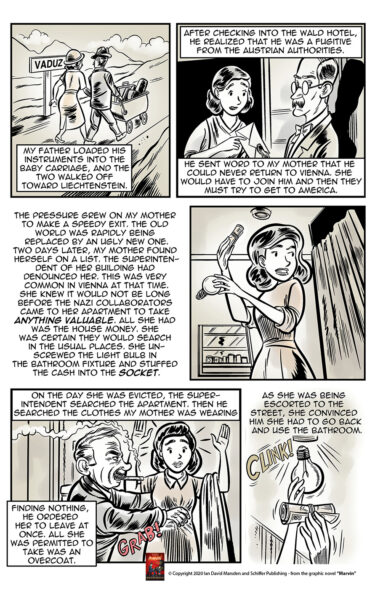
A family escape sequence from MARVIN: Max gets out first, Lilly is forced to leave the apartment, and the house money survives only because she hides it inside a bathroom light socket.
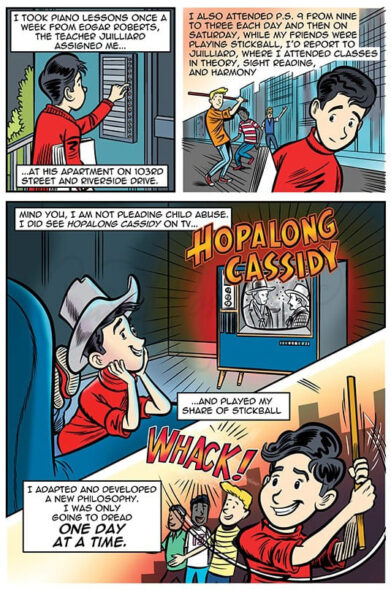
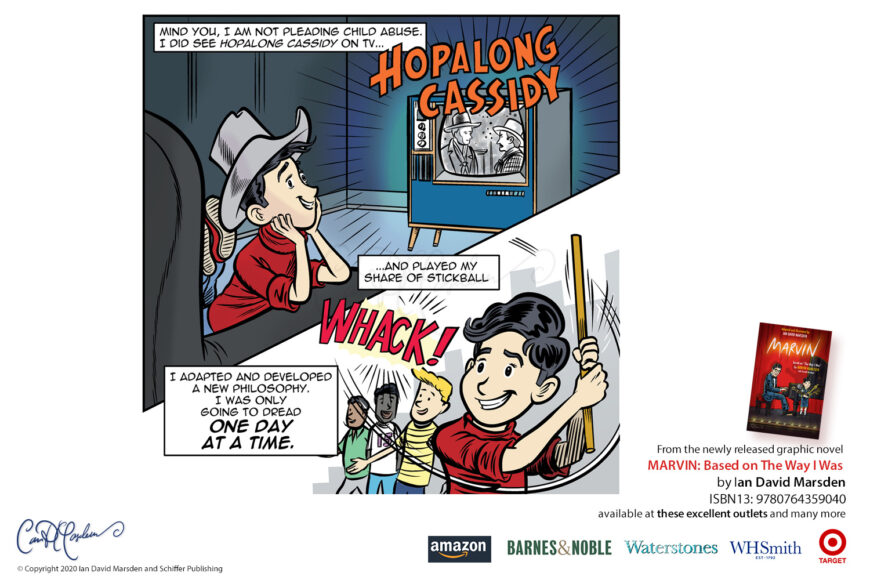
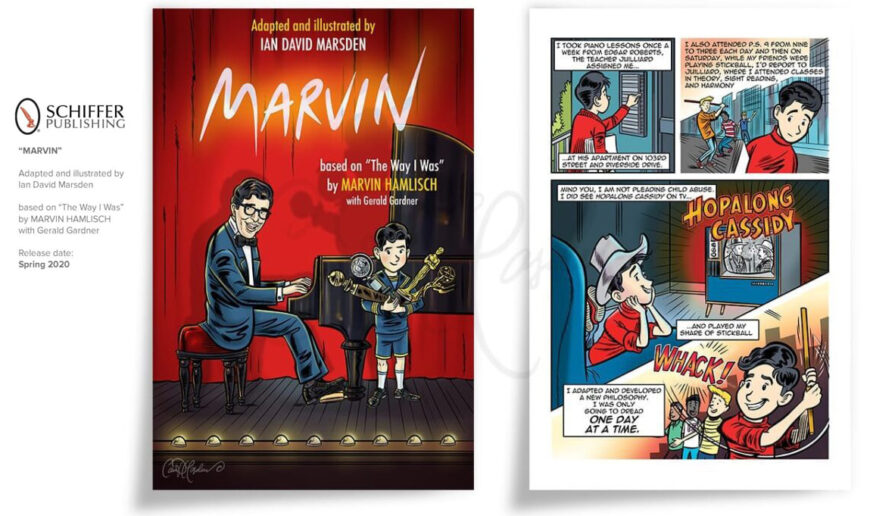
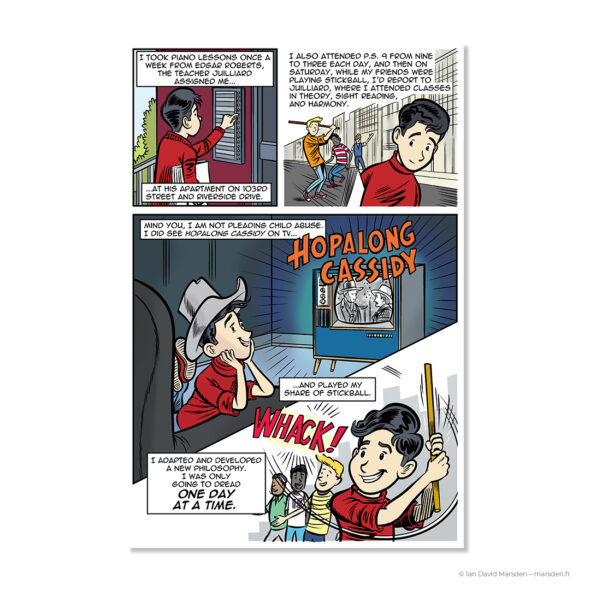
MARVIN Graphic Novel Page — Piano Lessons, Stickball and Hopalong Cassidy
A childhood page from MARVIN: piano lessons with Edgar Roberts, long days split between school and Juilliard, stickball with friends, and, when possible, Hopalong Cassidy on television.
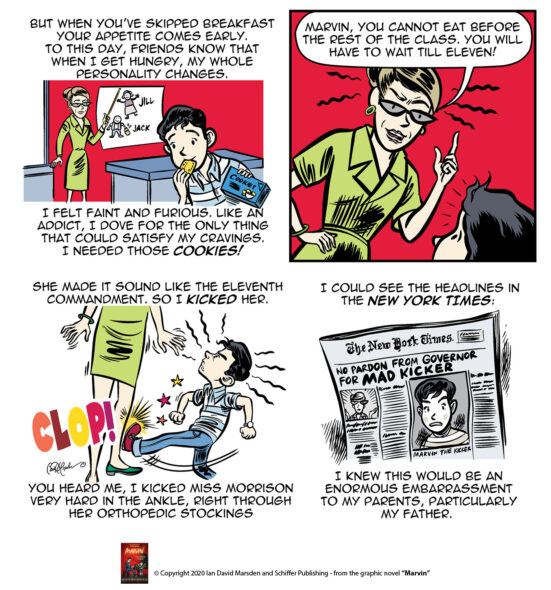
MARVIN Graphic Novel Page — Hungry Young Marvin Kicks Miss Morrison
A childhood disaster from MARVIN: denied his emergency cookies before snack time, young Marvin kicks Miss Morrison and instantly imagines the scandal reaching the front page of The New York Times.
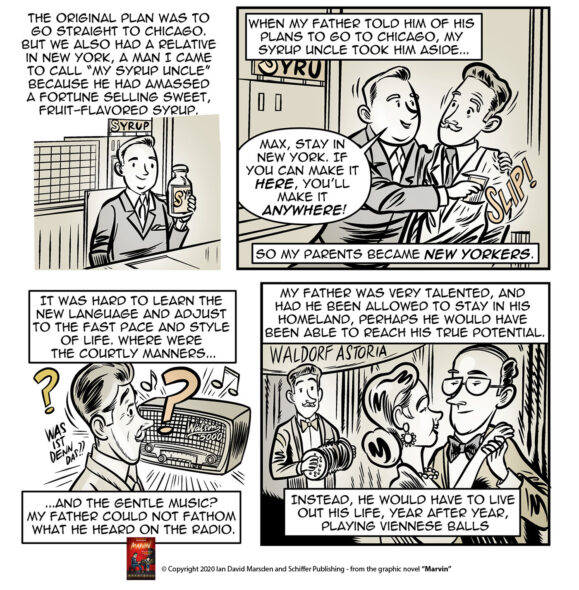
MARVIN Graphic Novel Page — Marvin Hamlisch’s Parents Settle in New York
A pre-Marvin family-history page from MARVIN: his father’s original plan to continue to Chicago changes in New York, where the family’s American life begins.
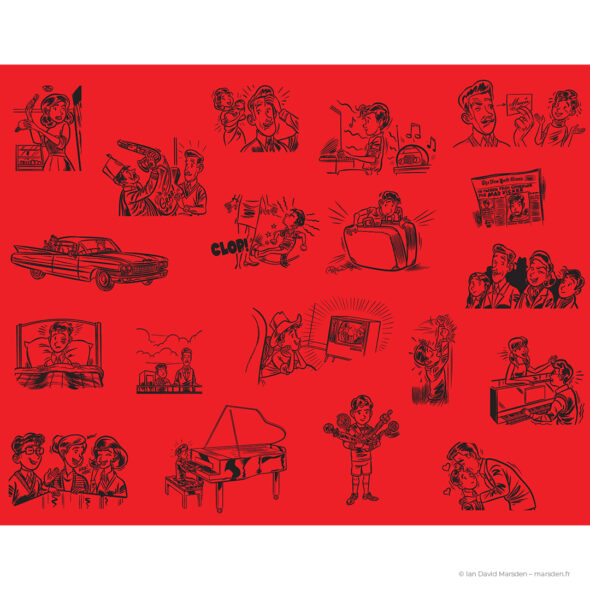
MARVIN Endpapers — Black-and-Red Vignettes from Marvin Hamlisch’s Life
Endpaper artwork for MARVIN, built from small black-line vignettes drawn from scenes across Marvin Hamlisch’s childhood, family life and musical career.
MARVIN Graphic Novel Page — Songwriting Conflict, David Merrick and the Rabbi’s Call
A page from MARVIN moving briskly from songwriting fury to theatrical rescue mission, then back to a childhood memory of an urgent call from the rabbi.
MARVIN Award Announcement — 2020 Purple Dragonfly Graphic Novel Winner
Award announcement image for MARVIN, winner of 1st Place in the Graphic Novel category of the 2020 Purple Dragonfly Book Awards.
MARVIN Graphic Novel — Purple Dragonfly Award 1st Place Graphic Novel
MARVIN: Based on The Way I Was by Marvin Hamlisch, published by Schiffer Publishing Ltd., received 1st Place in the 2020 Purple Dragonfly Book Awards Graphic Novel category.
MARVIN Graphic Novel Award Photo — Ian David Marsden with Published Book
Ian David Marsden with MARVIN, the graphic novel he adapted, wrote and illustrated, published by Schiffer Publishing Ltd. and awarded 1st Place in the 2020 Purple Dragonfly Book Awards Graphic Novel category.
MARVIN Graphic Novel Award Photo — Ian David Marsden with Published Book
Ian David Marsden with MARVIN, the graphic novel he adapted, wrote and illustrated, published by Schiffer Publishing Ltd. and awarded 1st Place in the 2020 Purple Dragonfly Book Awards Graphic Novel category.
MARVIN Promotional Comic — The Hamlisch Family at the Macy’s Thanksgiving Day Parade
A promotional MARVIN image from the Macy’s Thanksgiving Day Parade sequence, where Lilly Hamlisch’s encounter with the phrase “make elbows” marks another small step in becoming American.
MARVIN Graphic Novel — Photographs of the Printed Book, Interior Pages and Illustrator Biography
The finished printed edition of MARVIN, showing interior comic pages, the published cover and the “About the Illustrator” page from the Schiffer Publishing edition.
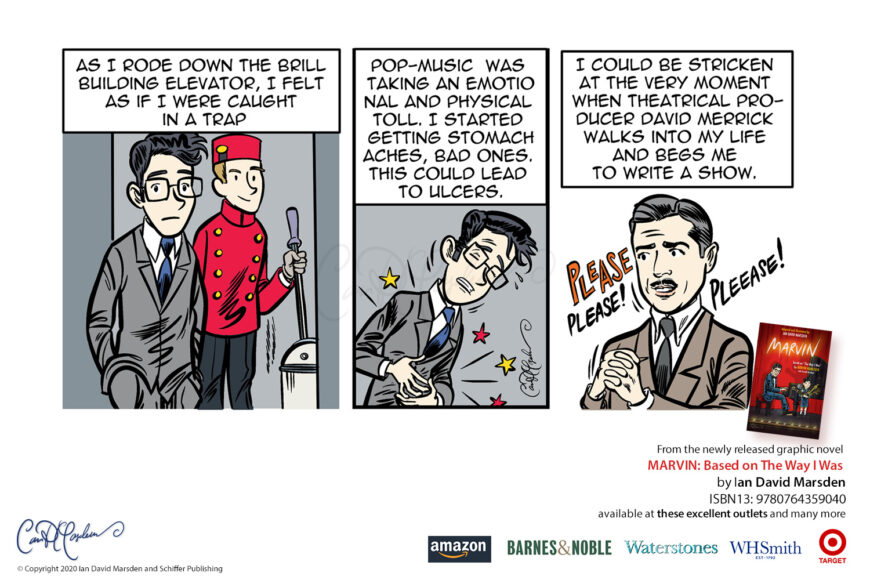
MARVIN Promotional Comic — Professional Stress, Pop-Music Stomach Aches and David Merrick’s Arrival
A wryly compressed career moment from MARVIN: one producer encounter ends badly, the ulcers begin queuing up, and then David Merrick appears, begging him to write a show.
MARVIN Graphic Novel Now Available — Promotional Comic Advertisement
Promotional announcement for the release of MARVIN, using a comic excerpt from the graphic novel alongside the book cover and bookseller references.
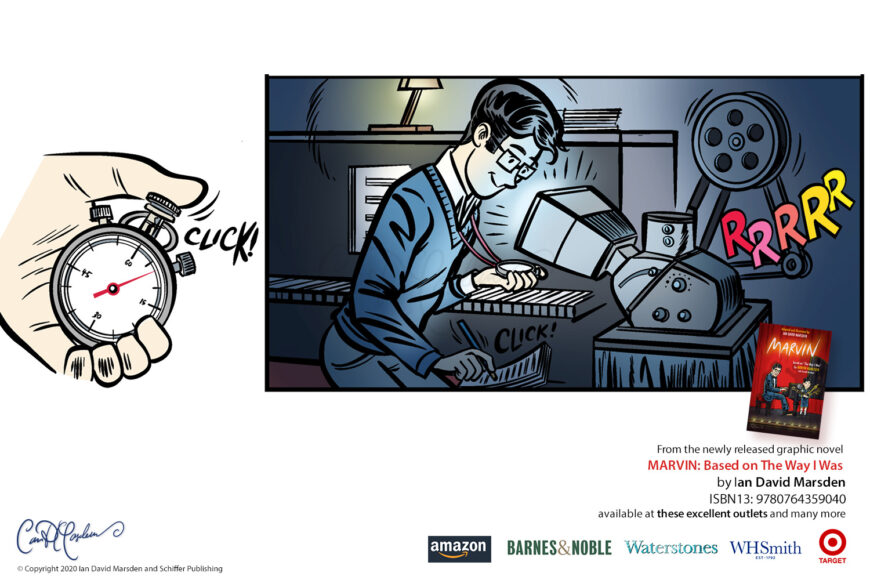
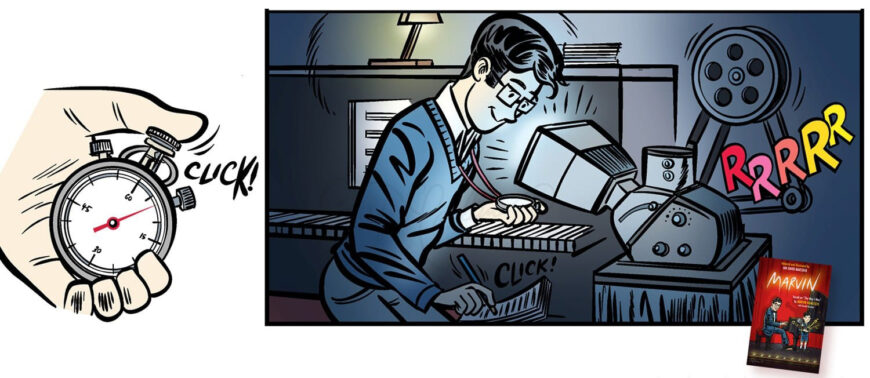
MARVIN Promotional Comic — Marvin Hamlisch Scores Film to Picture with Stopwatch and Moviola
Marvin Hamlisch works against the clock, composing music to picture with a stopwatch, piano and Moviola — an early lesson in the precise mechanics of film scoring.
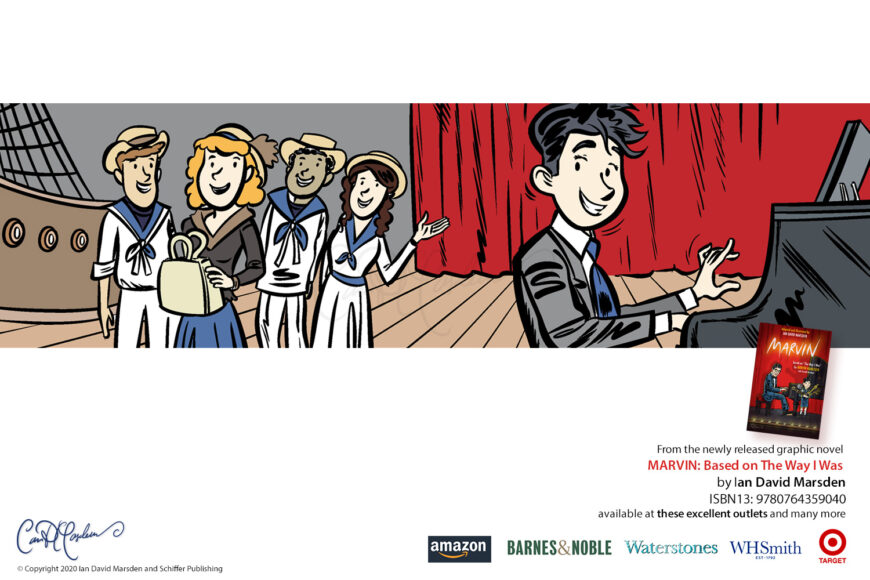
MARVIN Promotional Illustration — Young Marvin Performing Gilbert and Sullivan
Promotional artwork for MARVIN, using a theatrical scene of young Hamlisch at the piano during a stage production — the music came early, and very publicly.
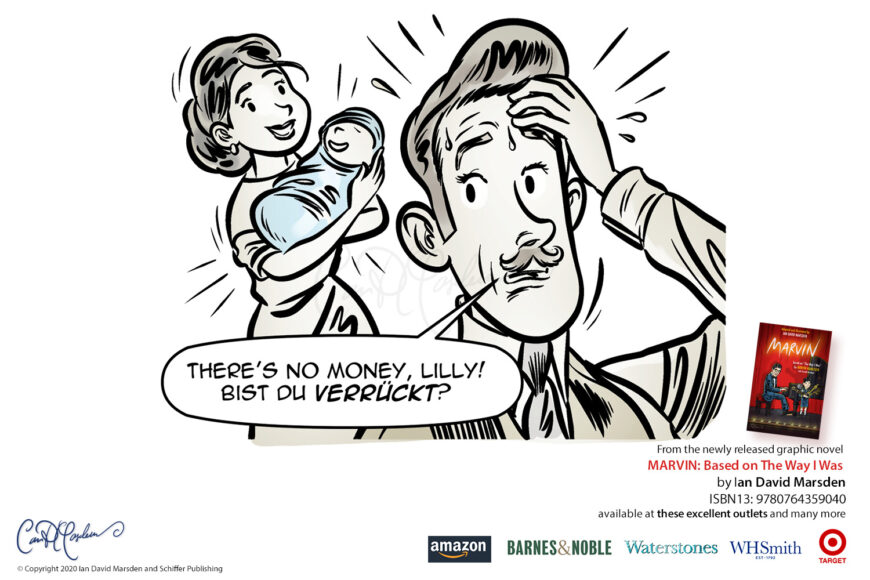
MARVIN Promotional Comic — Max and Lilly Hamlisch Face the Cost of a New Baby
A promotional MARVIN scene from the Hamlisch family’s early New York years: Lilly beams over the new baby; Max performs the traditional fatherly ritual of worrying about money.
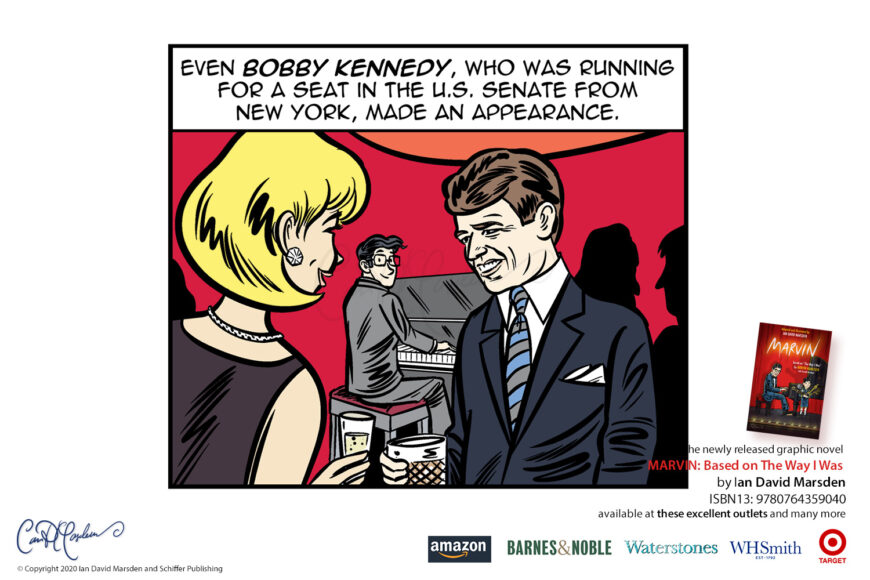
MARVIN Comic Scene — Robert F. Kennedy Appears at a Party
A scene from MARVIN recalling Robert F. Kennedy’s appearance at a party where the young Marvin Hamlisch was playing piano.
MARVIN Comic Panel — Hopalong Cassidy, Television and Stickball in Young Marvin Hamlisch’s New York Childhood
Young Marvin’s schedule was not entirely Juilliard and piano lessons. He also found time for Hopalong Cassidy on television and stickball in the street.
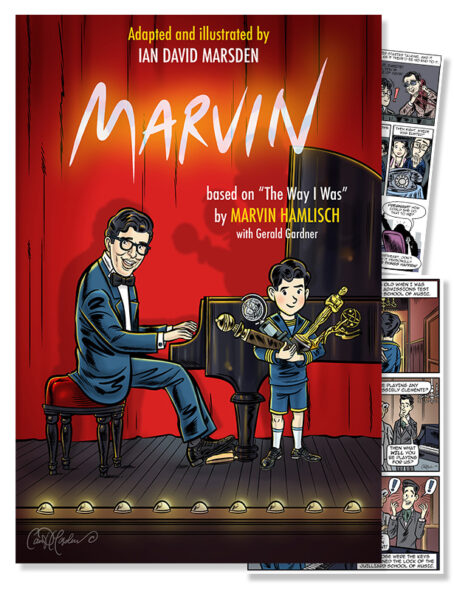
MARVIN Comics and Cartoons Collage — Graphic Novel by Ian David Marsden
Promotional collage for MARVIN, combining the finished book, interior comic pages and the cover artwork of Ian David Marsden’s graphic novel about Marvin Hamlisch.
MARVIN Featured in Schiffer Kids 2020 Catalog — Graphic Novel Artwork and Publisher Promotion
MARVIN featured in Schiffer Kids’ 2020 catalog, alongside a full comic page from the graphic novel and the publisher’s seasonal children’s-book presentation.
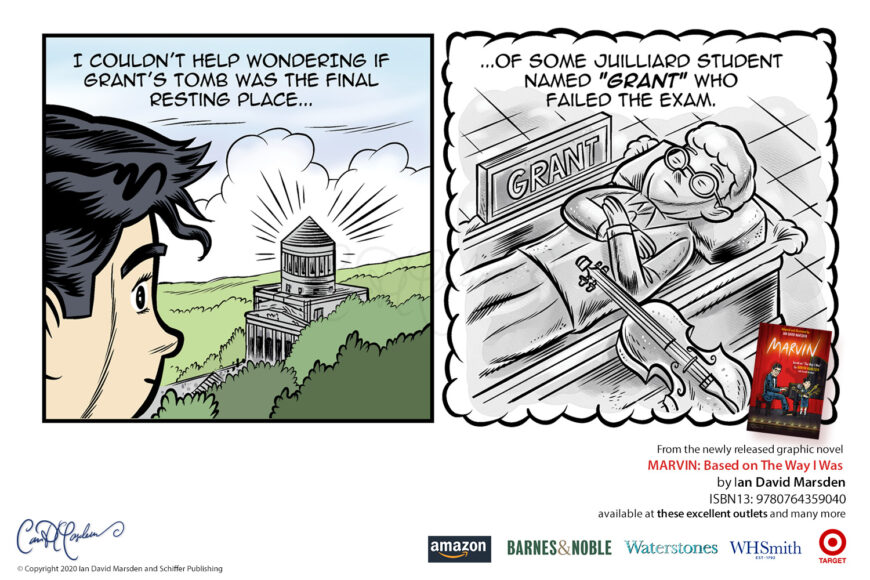
MARVIN Promotional Comic — Grant’s Tomb and a Juilliard Joke
A promotional MARVIN comic built around a childhood New York misreading: Grant’s Tomb becomes, in Marvin’s imagination, the final resting place of a failed Juilliard student named Grant.
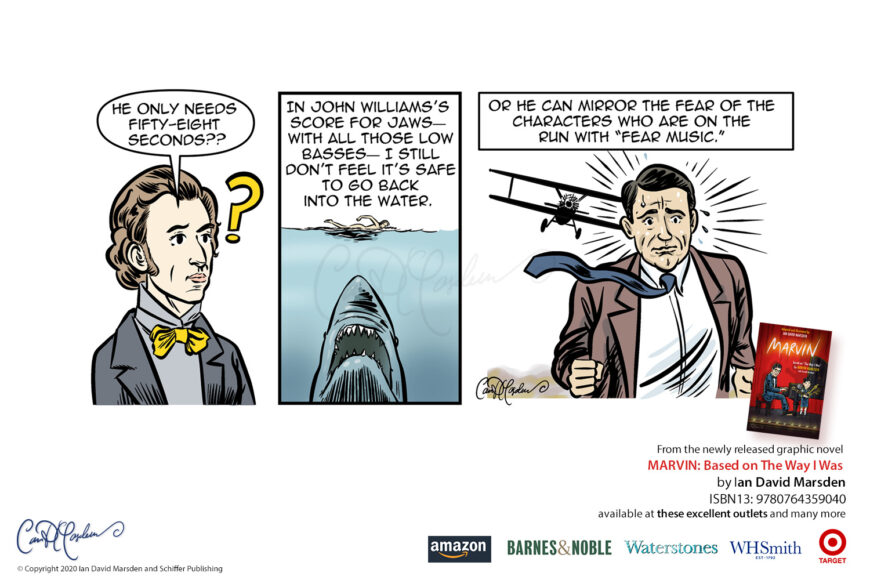
MARVIN Promotional Comic — Chopin, Jaws and Cary Grant in North by Northwest
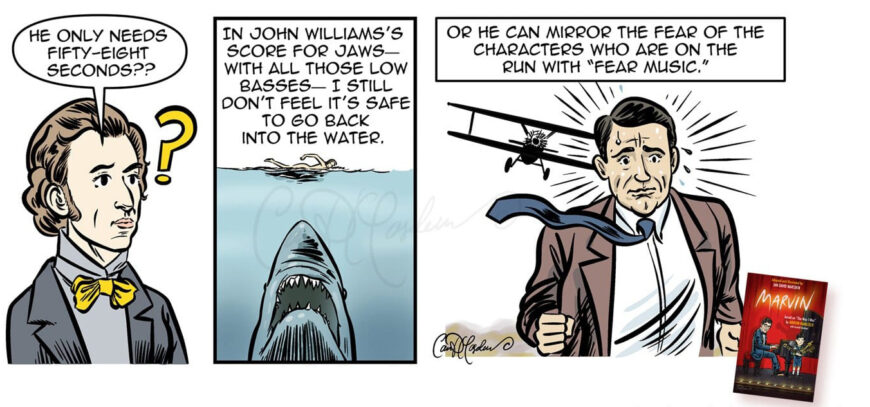
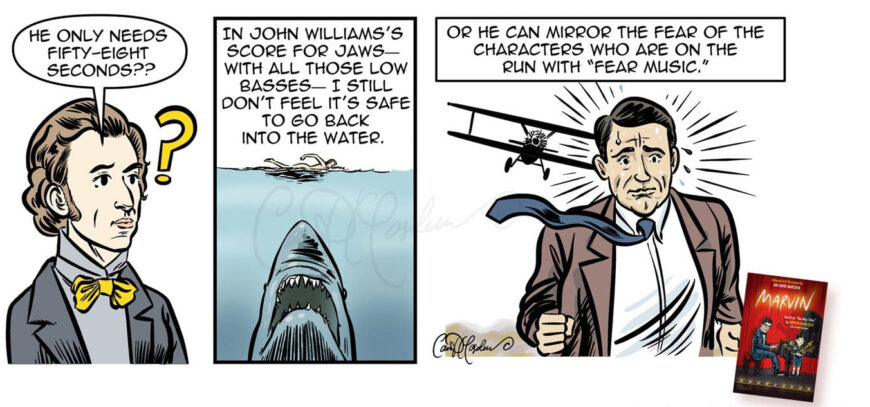
A promotional MARVIN comic built around musical timing: fifty-eight seconds can feel radically different depending on whether they are shaped like Chopin, Jaws or Cary Grant running from a crop-duster.
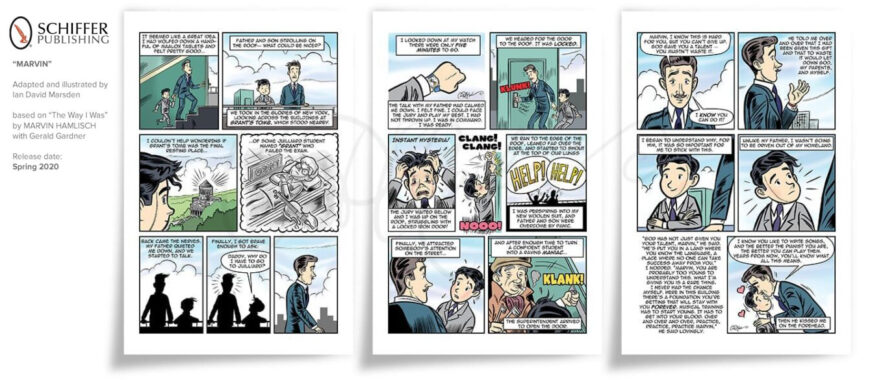
MARVIN Promotional Comic — Marvin Locked Out on the Roof and the Superintendent Opens the Door
A comic scene from MARVIN: stranded on the roof after an ill-considered experiment, young Marvin attracts help from the street below — and eventually the superintendent with the keys.
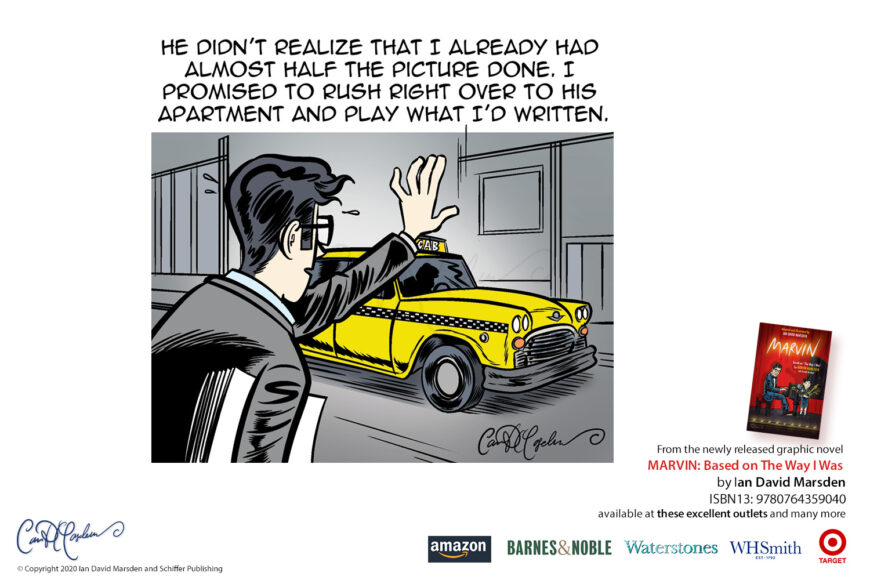
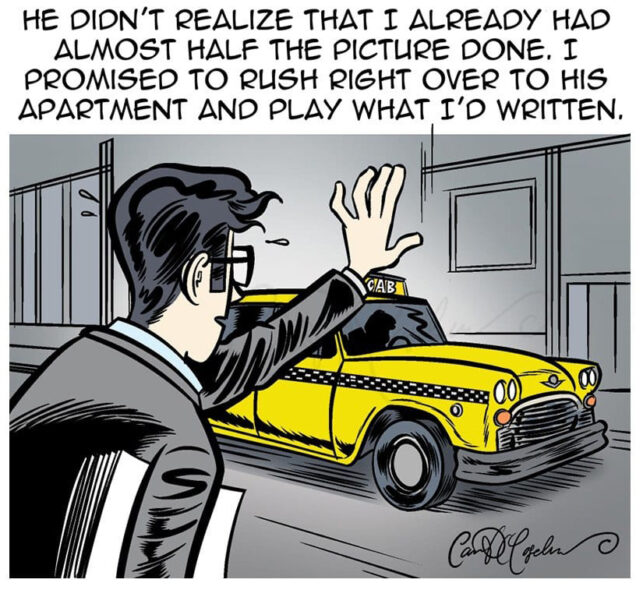
MARVIN Promotional Comic — Marvin Hamlisch Hails a Taxi with Half the Film Score Already Written
A promotional MARVIN image of Hamlisch racing toward the next deadline, having already written nearly half the picture before the producer realizes it.
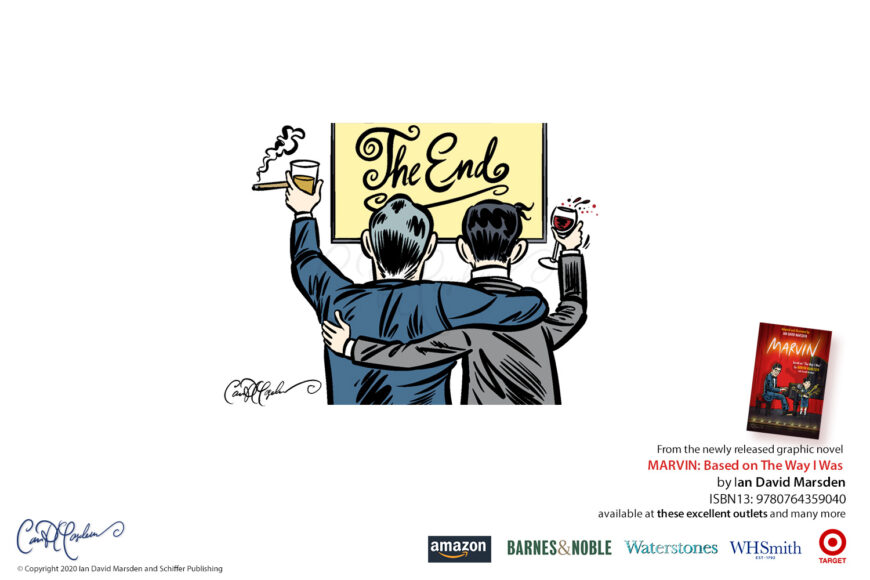
MARVIN Promotional Image — “The End” Film-Music Finale
A celebratory “The End” image from the MARVIN film-scoring sequence: the picture is finished, the glasses are raised, and the young composer has survived the ordeal.
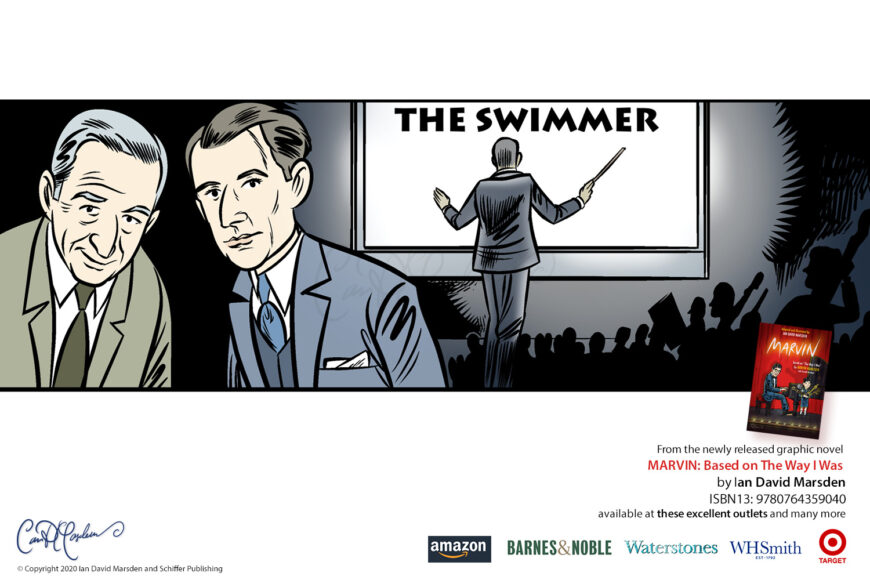
MARVIN Promotional Comic — Sam Spiegel and Frank Perry Present The Swimmer
A promotional image from the MARVIN film-scoring sequence, referring to The Swimmer, the 1968 Burt Lancaster film for which Marvin Hamlisch composed the score.
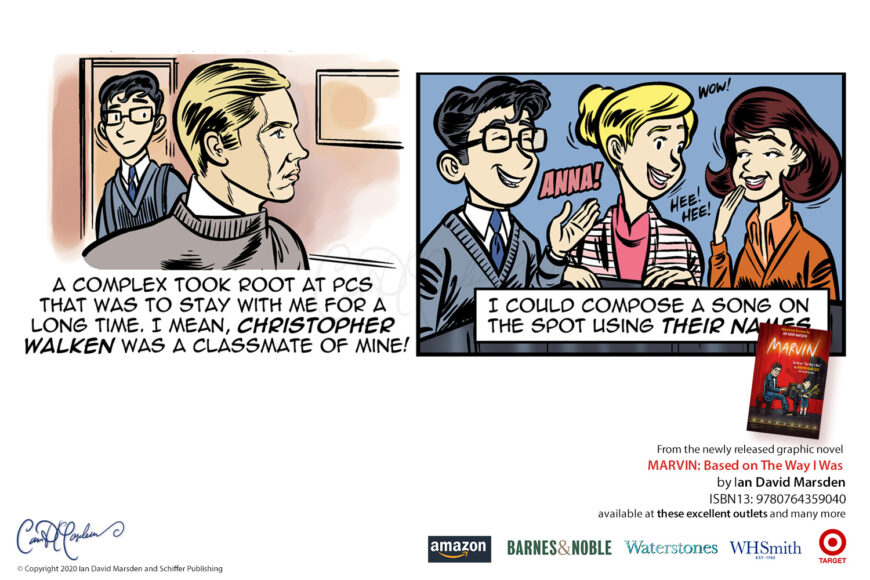
MARVIN Promotional Comic — Christopher Walken at School and a Song Written on the Spot
A promotional MARVIN image with two episodes from Hamlisch’s youth: the unexpected fact that Christopher Walken was a schoolmate, and Marvin discovering he could compose a song almost on demand.
MARVIN Promotional Comic — Doctor’s Visit After Completing the Film Score
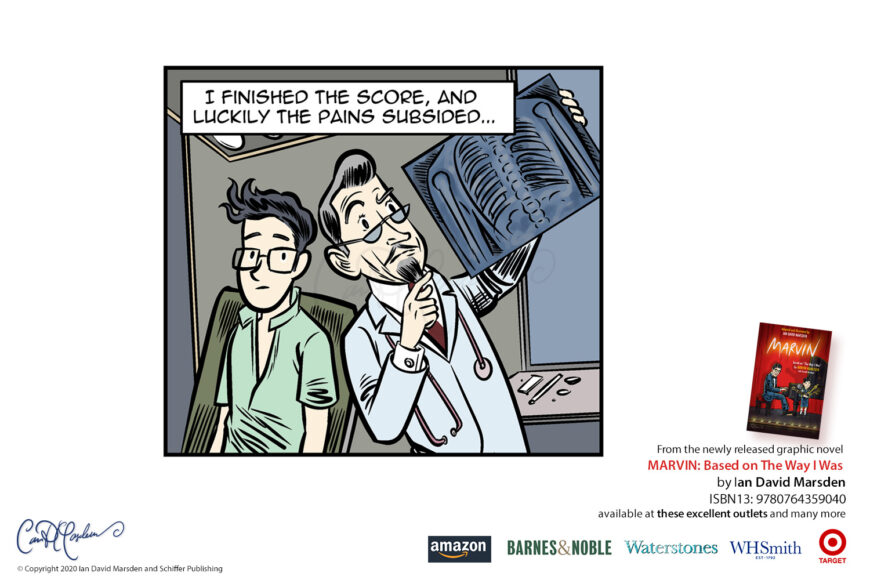
After finishing the score, Marvin’s pains subside — a small moment of physical relief after the pressure of his early film-composing work.
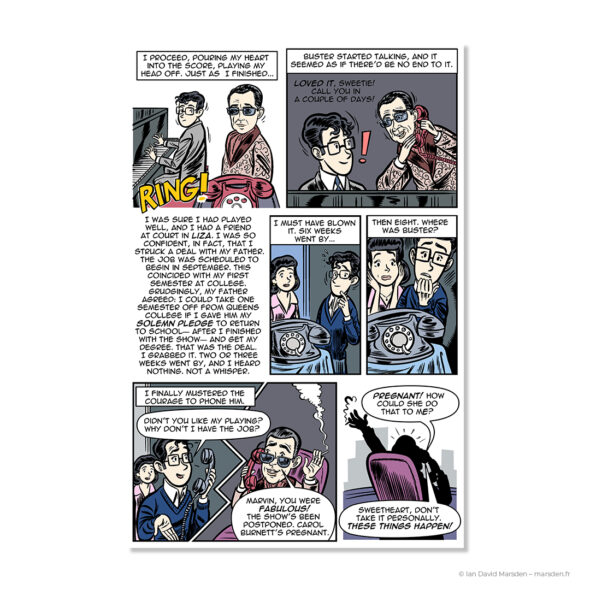
MARVIN Graphic Novel Page — Liza Minnelli, Carol Burnett and the Delayed Broadway Job
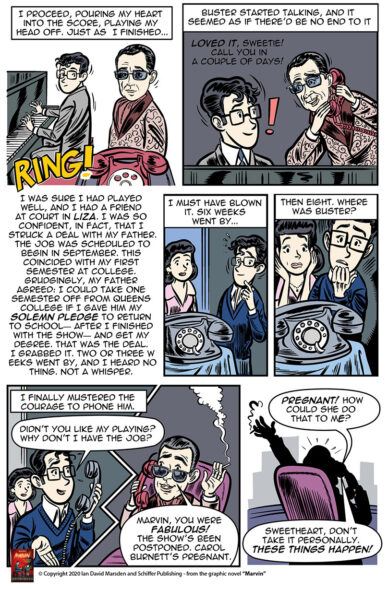
A page from MARVIN recounting an early professional near-break: Marvin plays confidently for Liza Minnelli, waits six anxious weeks for news, then learns from Buster that the Carol Burnett production has been postponed.
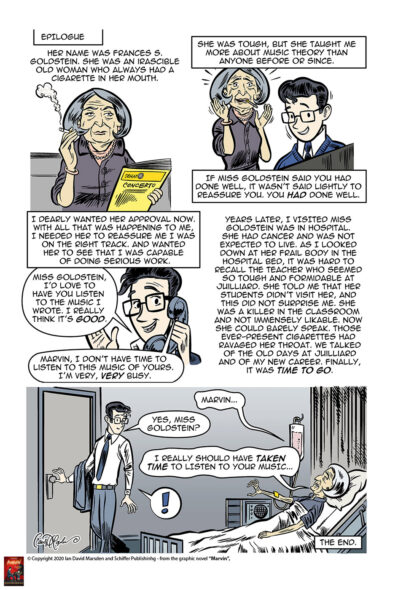
The epilogue of MARVIN returns to Frances S. Goldstein, Marvin Hamlisch’s formidable Juilliard teacher — a woman whose approval he wanted badly, and whose importance he understood more fully years later.
MARVIN Published Graphic Novel — Printed Interior Pages and About the Illustrator
The published edition of MARVIN, shown open to several interior spreads and the book’s “About the Illustrator” page.
MARVIN Graphic Novel Presentation — Book Cover and Hopalong Cassidy Childhood Page
Portfolio spread for MARVIN, pairing the published cover with a childhood page in which young Hamlisch moves between piano lessons, Juilliard, Hopalong Cassidy and stickball.
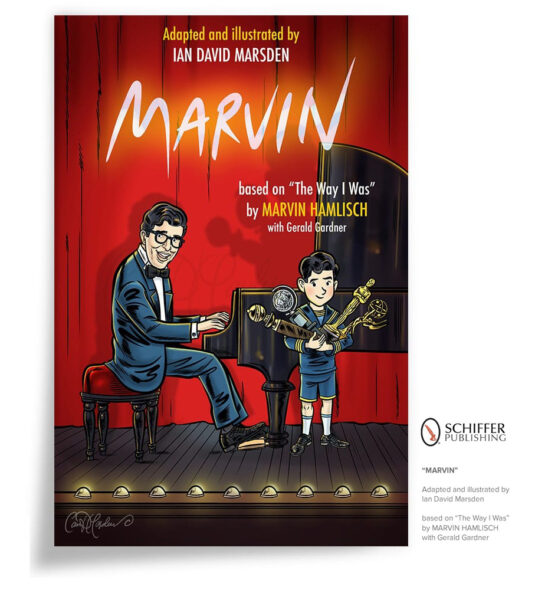
Cover presentation for MARVIN: Based on The Way I Was by Marvin Hamlisch, adapted, written and illustrated by Ian David Marsden and published by Schiffer Publishing Ltd.
Marvin001-Cover-IanDavidMarsden-1-comics
MARVIN Comic Page — Waiting for Buster’s Phone Call After the Liza Minnelli Audition
From MARVIN: six weeks of silence after a promising audition, followed by the least consoling professional update imaginable.
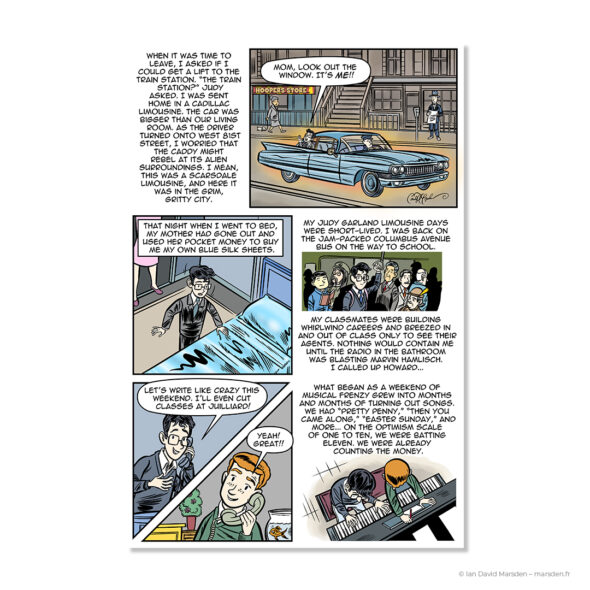
MARVIN Graphic Novel Page — Judy Garland’s Limousine, Blue Silk Sheets and the Brill Building
A wonderfully lopsided weekend in MARVIN: Judy Garland’s limousine delivers the teenage songwriter home, his mother buys him blue silk sheets, and by Monday he is back on the bus to school — already writing songs in earnest.
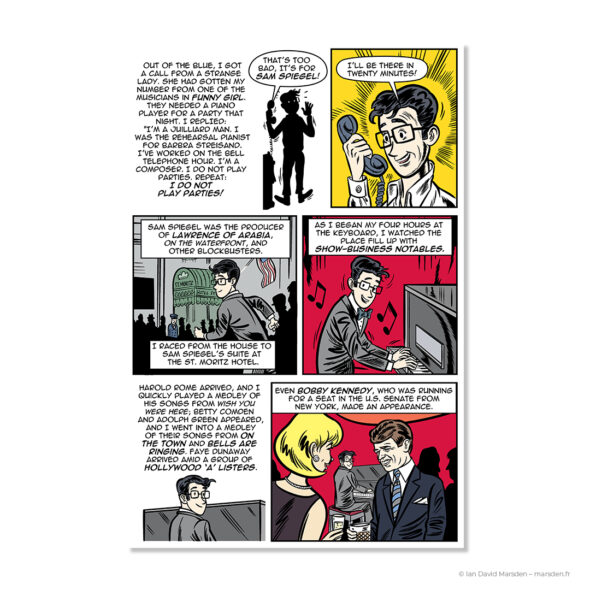
MARVIN Graphic Novel Page — Sam Spiegel’s Party with Harold Rome, Bobby Kennedy and Hollywood Guests
A page from MARVIN recounting an absurdly rapid rise in social altitude: a mysterious call, Sam Spiegel’s suite at the St. Moritz Hotel, Hollywood guests, Harold Rome, Betty Comden, Adolph Green — and Bobby Kennedy making an appearance.
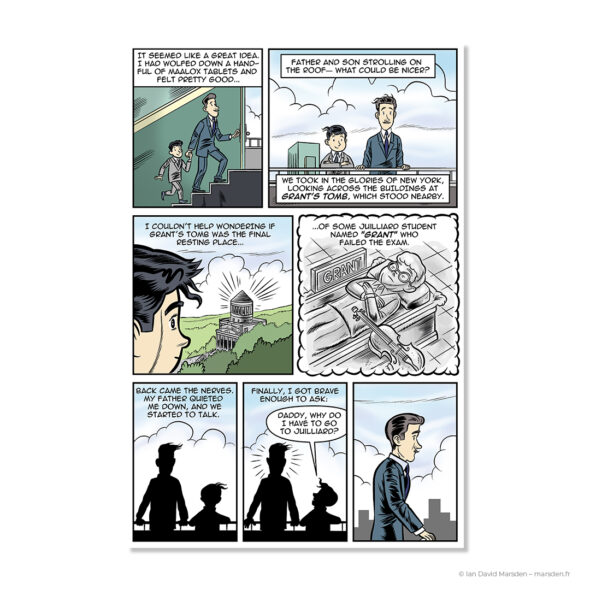
Marvin: Based on “The Way I Was” – Tomb of Grant Scene
A reflective moment from Marvin: Based on “The Way I Was”, as Marvin visits the tomb of Ulysses S. Grant with his father — from Ian David Marsden’s graphic novel.
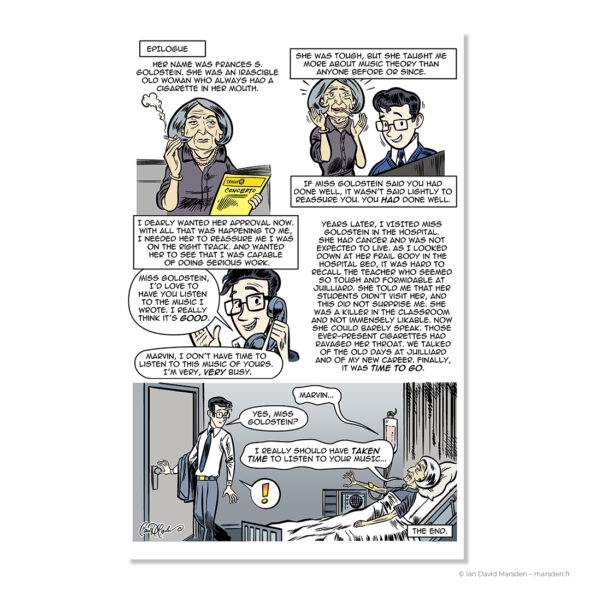
MARVIN Final Page — Frances S. Goldstein, Marvin Hamlisch’s Juilliard Teacher
The closing page of MARVIN, returning to Frances S. Goldstein — the formidable Juilliard teacher whose approval Marvin once badly wanted, and whom he later visited near the end of her life.
marvin-train
MARVIN Film Music Comic — John Williams’s Jaws and Cary Grant in North by Northwest
A film-music joke created for the promotion of MARVIN, using Jaws and North by Northwest to explain how much emotion a short stretch of music can carry.
MARVIN Graphic Novel Page — The Stopwatch, the School Piano and Miss Sussman
After the “mad kicker” incident, things improve. Marvin receives a stopwatch, is allowed to eat when hungry, returns to class with confidence, and discovers that a piano has materialized at school.
MARVIN Promotional Comic — Film Music, John Williams’s Jaws Theme and Fear Music
A promotional MARVIN image about film scoring: the practical objection, the Jaws example, and the deceptively difficult business of writing music that mirrors fear on screen.
MARVIN Comic Detail — Grant’s Tomb Misunderstood by Young Marvin
Young Marvin considers Grant’s Tomb and arrives at an entirely plausible explanation, at least by the standards of a child attending Juilliard.
MARVIN Graphic Novel Pages — Marvin Hamlisch and His Father on the Rooftop
Three pages from MARVIN, adapted, written and illustrated by Ian David Marsden, including a key rooftop conversation between young Marvin Hamlisch and his father.
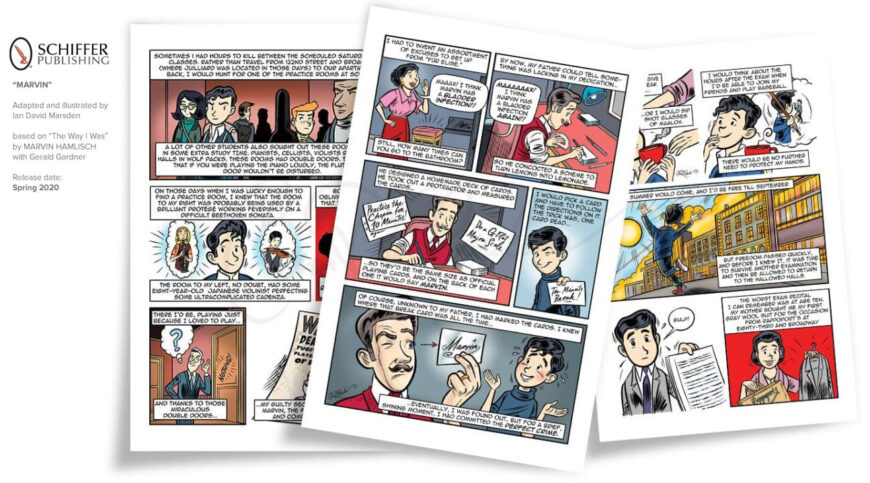
MARVIN Graphic Novel Sample Pages — Childhood Episodes and Early Ambition
Sample interior pages from MARVIN, moving through childhood pressure, comic mischief and the brief liberty of summer.
MARVIN Promotional Comic — Composing to Picture with Stopwatch, Piano and Moviola
Marvin Hamlisch composes to picture with stopwatch, piano and Moviola — learning that film music is measured not only in emotion, but in seconds.
MARVIN Comic Scene — Hailing a New York Checker Cab
Marvin hails a Checker cab and heads off to play the music he has already written — rather more of it than the producer expected.
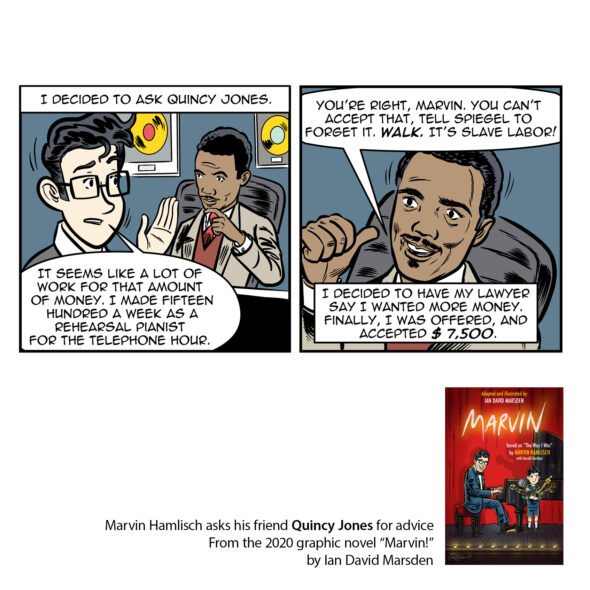
MARVIN Graphic Novel Scene — Quincy Jones Advises Marvin Hamlisch on Sam Spiegel’s Offer
Marvin Hamlisch asks his friend Quincy Jones for advice after producer Sam Spiegel offers him $2,500 to compose the score for a feature film. Quincy’s verdict is admirably direct.
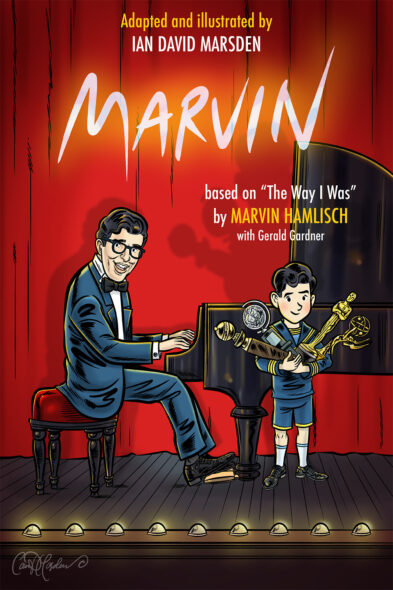
MARVIN Graphic Novel Cover — Illustrated Biography of Marvin Hamlisch by Ian David Marsden
Cover of MARVIN: Based on The Way I Was by Marvin Hamlisch, adapted, written and illustrated by Ian David Marsden.
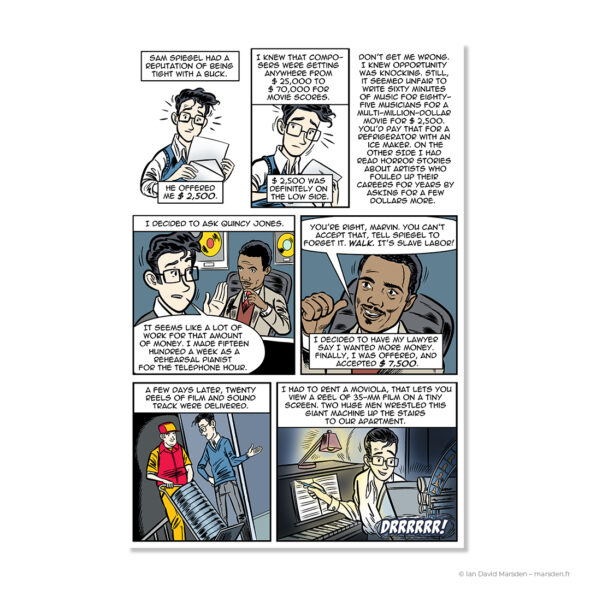
MARVIN Graphic Novel Page — Sam Spiegel’s Offer, Quincy Jones’s Advice and the Moviola Arrives
A page from MARVIN covering Marvin Hamlisch’s first serious film-scoring opportunity: Sam Spiegel’s underwhelming offer, Quincy Jones’s firm advice, a better deal, and the arrival of a rented Moviola in the apartment.
MARVIN Cover Art — Graphic Novel About Marvin Hamlisch
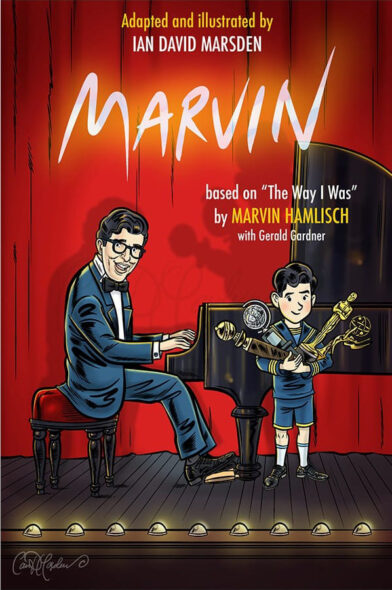
The main cover artwork for MARVIN, the graphic novel about Marvin Hamlisch adapted, written and illustrated by Ian David Marsden.
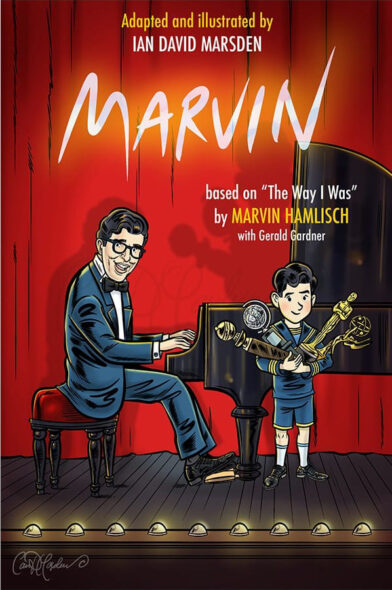
MARVIN Graphic Novel Cover by Ian David Marsden
Full book cover for MARVIN: Based on The Way I Was by Marvin Hamlisch, published by Schiffer Publishing Ltd.
MARVIN Graphic Novel Page — Juilliard, Hopalong Cassidy and Stickball
A page from MARVIN about the crowded architecture of a gifted child’s week: piano lessons, public school, Juilliard, Hopalong Cassidy, and whatever stickball could still be rescued from the schedule.
Blue Suit Serenade on a Red Stage
Cover: Marvin graphic novel by Ian David Marsden
Cover illustration for Marvin, a graphic novel by Ian David Marsden based on The Way I Was by Marvin Hamlisch — published by Schiffer Publishing.
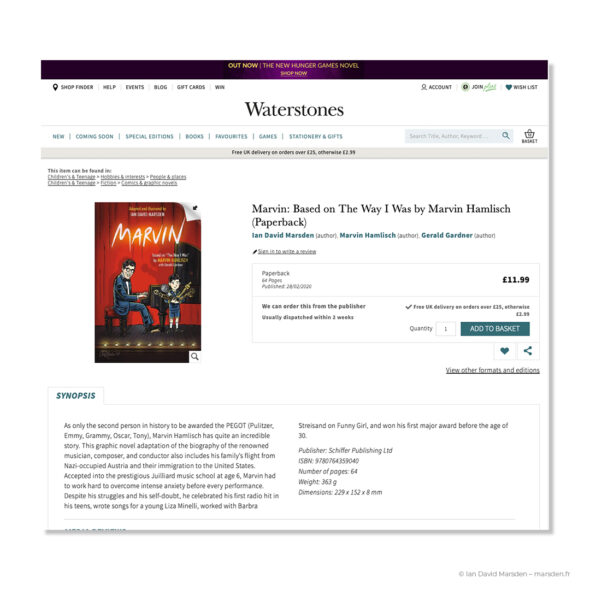
MARVIN Graphic Novel — Waterstones Retail Listing for Ian David Marsden’s Book
Waterstones retail listing for MARVIN: Based on The Way I Was by Marvin Hamlisch, the graphic novel adapted, written and illustrated by Ian David Marsden.
MARVIN Graphic Novel Listing at Barnes & Noble
Barnes & Noble listing for MARVIN: Based on The Way I Was by Marvin Hamlisch, the graphic novel adapted, written and illustrated by Ian David Marsden.
We use essential cookies to operate this website and, with your permission, optional technologies for visitor statistics and embedded videos. You can accept, reject or adjust your preferences at any time.
Functional
Always active
Essential technologies required for the website to function correctly and securely. These cannot be disabled through the consent settings.
Preferences
Technologies that remember your choices and preferences to improve your experience on this website.
Statistics
With your consent, Google Analytics helps us understand how visitors use the website so we can improve its content and performance.The technical storage or access that is used exclusively for anonymous statistical purposes. Without a subpoena, voluntary compliance on the part of your Internet Service Provider, or additional records from a third party, information stored or retrieved for this purpose alone cannot usually be used to identify you.
Marketing
With your consent, marketing technologies may be used for Google Ads conversion measurement and to support advertising-related features. We do not currently run advertising campaigns.