
Business Comics · Explainer Comics · Learning · Sequential Illustration
Business Comics, Explainer Comics & Short Graphic Novels
I create custom comic strips, sequential illustrations, learning comics and short graphic novels for companies, institutions, publishers and organisations — developed around a specific brief, audience and communication objective.
Projects can range from a two-panel behavioural explanation to a complete illustrated booklet, training story or multi-page narrative, with script development, visual structure, characters, illustration and final production developed as one coherent system.

From a single strip to a complete illustrated narrative
Business comics do not need to follow one fixed format.
Depending on the brief, the most useful solution may be:
- a two- or three-panel explainer strip
- a recurring educational comic series
- a poster built around sequential scenes
- an onboarding or training comic
- a customer-information sequence
- an illustrated guide or handbook
- a short branded graphic novel
- a longer commissioned sequential publication
- comic artwork adapted into animation or video
The form follows the communication problem. A simple behavioural point may need only two images; a complex culture, training or historical subject may need dozens of pages.
Created from the client brief — not fitted to a stock comic format
The starting point is the communication objective.
What needs to be understood? Who needs to understand it? What happens before and after the key moment? What should the reader remember or do differently afterwards?
From there, I can develop the material into scenes, characters and sequential actions. Depending on the project, I may work from a finished script, edit existing material or help structure the narrative from the original briefing.
This makes the comic a purpose-built communication tool rather than an illustration style added at the end of a project.
Comic strips for learning & behaviour change
Sequential illustration is particularly effective when the subject involves actions, choices, consequences or changes over time.
A single illustration can show a situation. A comic can show what happens next.
That makes the format useful for:
- employee training
- health and safety
- onboarding
- sustainability and energy awareness
- customer education
- workplace behaviour
- process explanation
- compliance communication
- public-information campaigns
- e-learning
Very short comics can carry a complete idea
At the most compact end of the scale, comic strips can communicate a behavioural message using only a few sequential images.
For Coca-Cola, I created comic-strip material around recycling behaviour, demonstrating how sequential drawing can communicate an action clearly even when very little space is available.

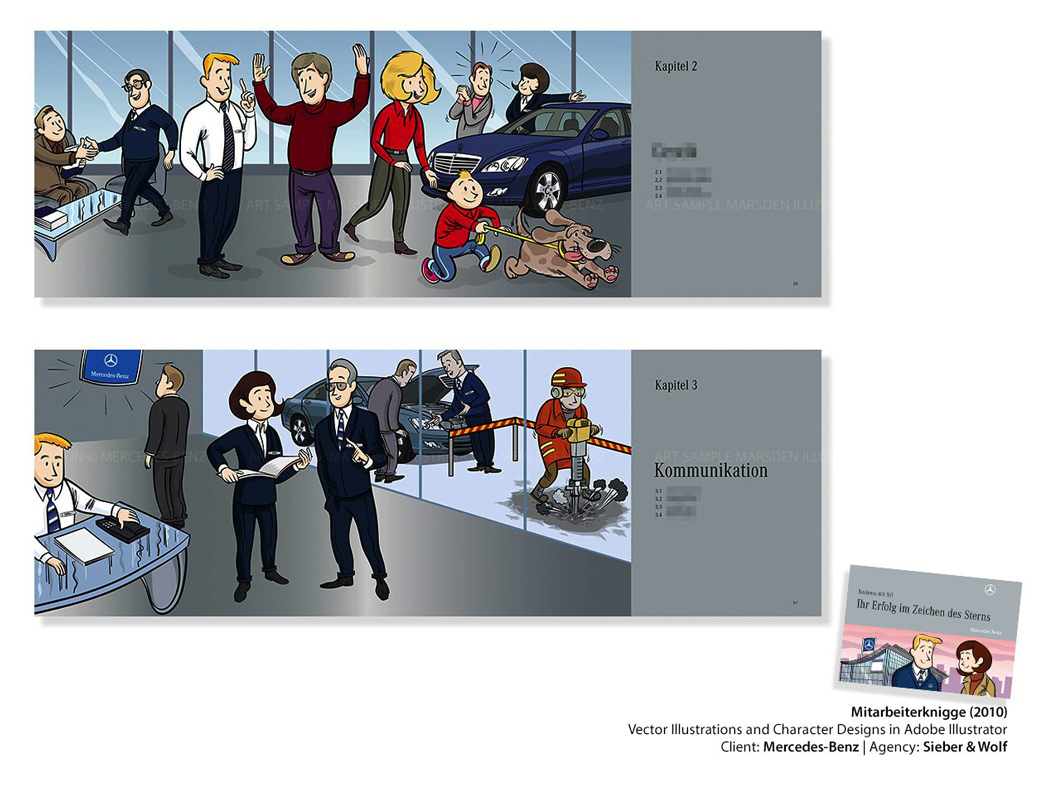
Mercedes-Benz — when the comic becomes a book
At the other end of the scale is my work for Mercedes-Benz, where sequential illustration was developed across a substantial illustrated publication rather than a single strip.
The Mercedes project demonstrates how business-comic techniques can support a longer reading experience: recurring characters, workplace situations, chapter structure, visual continuity, humour and a sustained narrative tone across many pages.
That kind of project sits somewhere between corporate publishing, educational comics and a commissioned short graphic novel.
Short graphic novels & illustrated corporate books
Some subjects need more space than an explainer strip can provide.
A company history, behavioural guide, cultural programme, educational subject or complex internal story may work better as a booklet or short graphic novel with chapters, recurring characters and a more developed narrative arc.
In those cases, my role can include:
- narrative development
- script editing or adaptation
- story structure
- page breakdown
- storyboarding
- character development
- sequential illustration
- dialogue and caption placement
- page composition
- final production artwork
Dräger — comics across posters, communication & video
The Dräger project shows another advantage of building communication around sequential illustration: the underlying scenes can move between formats.
Comic-based visual storytelling was used to communicate subjects around infection prevention and professional behaviour through illustrated poster material and related moving-image content.
This makes one illustrated concept useful across several channels while preserving the same characters, tone and visual logic.
From printed comic to animated sequence
Sequential artwork already contains many of the ingredients needed for motion: characters, scenes, actions, changes of expression and visual progression.
For selected projects, the same artwork can therefore be adapted into:
- animated comic strips
- explainer-video scenes
- e-learning sequences
- social-media clips
- presentation animations
- training-video inserts
The printed and moving versions do not have to be identical. The important part is that both grow from the same narrative and visual system.
Comics & illustration in motion
A selection of animated and illustrated video work showing how drawn storytelling can continue beyond the printed page.
SUSTAIN-D — learning comics for everyday energy behaviour
For SUSTAIN-D, a recurring series of short comics was developed around household energy use and practical behaviour change.
Each strip takes one everyday subject and turns it into a compact visual scenario. The format is deliberately simple: familiar setting, clear action, consequence and alternative behaviour.
This is a good example of comics working as an educational system rather than entertainment added to information.

Visual-first does not have to mean wordless
Some projects communicate primarily through images. Others need dialogue, labels, captions, numbers or explanatory text.
I do not treat “wordless” as a rule.
The better question is how much information the image can carry and where text genuinely helps. A good business comic uses the two together rather than forcing everything into either pictures or prose.
For multilingual projects, visual structure can reduce dependence on text while still allowing the information that needs precise wording to remain explicit.

Where business comics can be used
- internal communication
- employee onboarding
- training and e-learning
- health and safety
- ESG and sustainability communication
- customer education
- technical explanation
- corporate culture and behaviour
- illustrated handbooks
- product and service explanation
- public-information campaigns
- conference and presentation material
- social and digital communication
- corporate publishing
From briefing to finished comic
- briefing and communication objective
- audience and intended use
- script development or adaptation
- narrative structure
- storyboard and page breakdown
- character development
- sketches and approval stages
- final sequential illustration
- layout and production
- adaptation for print, digital or motion where required
For larger projects, this process makes it possible to establish the story and page logic before committing to the complete final artwork.
Disciplines
- Business Comics
- Explainer Comics
- Learning Comics
- Sequential Illustration
- Graphic-Novel Development
- Script & Narrative Development
- Storyboarding
- Character Design for Sequential Stories
- Editorial Illustration
- Information Design
- Visual Storytelling
- 2D Animation & Motion Adaptation
Business-comic case studies
Projects including Mercedes-Benz, Dräger and SUSTAIN-D can also be explored through the project archive and downloadable case studies.
Related illustration & storytelling services
Business Comics & Sequential Illustration →
Editorial & Educational Illustration →
Have something that would work better as a comic?
Send me a brief outline of the subject, audience, intended use and approximate scope. I can help shape it into anything from a short explainer strip to a complete illustrated booklet or commissioned graphic narrative.