Animated Commercials · Character Design · Illustration · Limited Animation
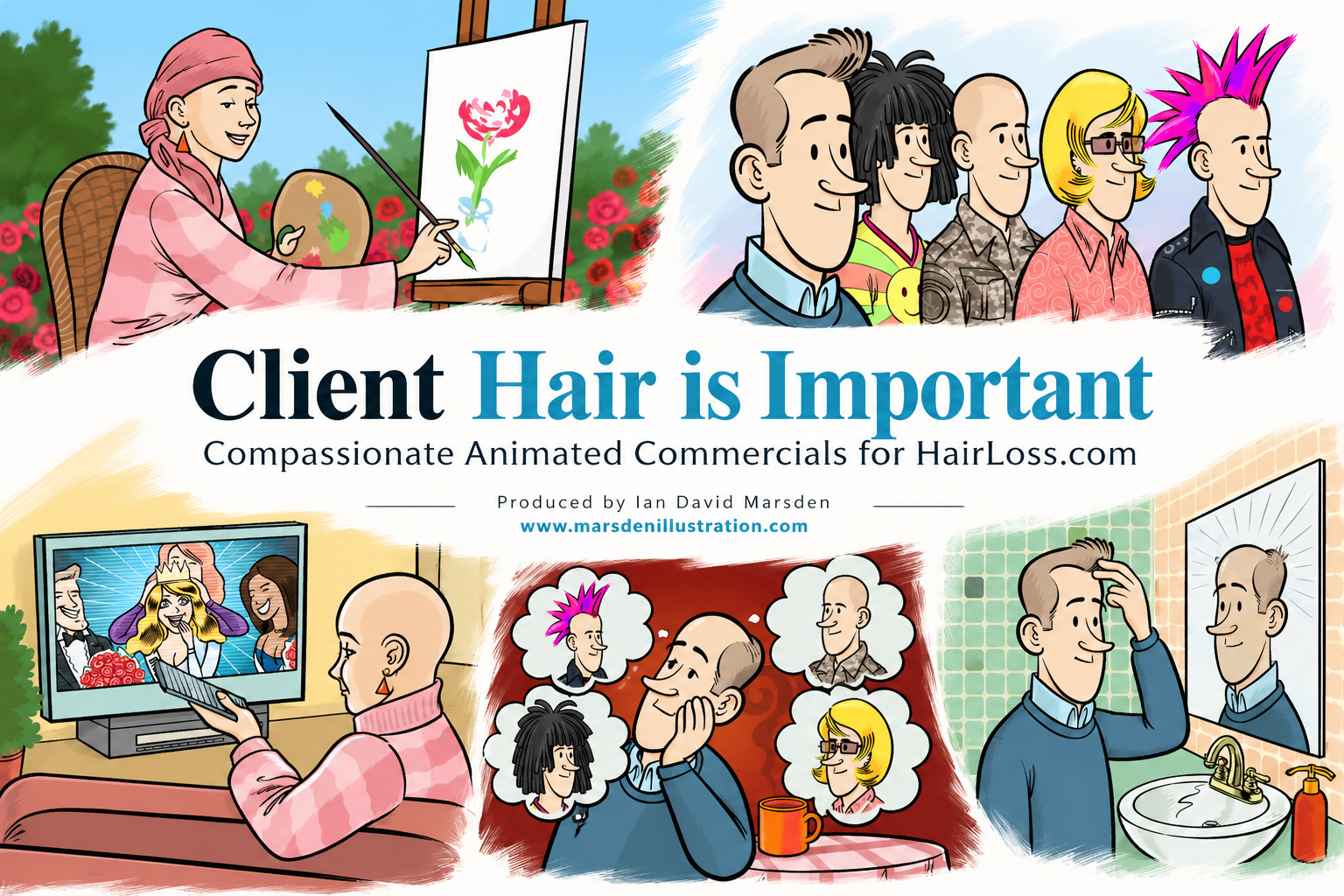
Hair is Important — Compassionate Animated Commercials for HairLoss.com
Hair is Important was a series of six short animated films for HairLoss.com, approaching hair loss not simply as a cosmetic issue but as something closely tied to identity, confidence, relationships and emotional wellbeing.
Small films with a human message
The films were created around scripts and voiceovers supplied by Bright Bulb Solutions in the United States. My task was to turn those spoken stories into complete visual narratives.
That meant developing the visual concept for each film, planning the storytelling through storyboards, designing characters and environments, creating the finished illustrations and then bringing them to life through restrained 2D animation.
The subject required sensitivity. Hair loss can be connected to alopecia, trichotillomania, cancer treatment, hereditary hair loss or other circumstances, but the emotional experience is different for every person. The films needed warmth and compassion without becoming sentimental or clinical.
From voiceover to finished picture
Building a visual story around an existing script
Because the script and recorded voiceover already existed, the visual work had to respond very closely to rhythm, language and emotional emphasis. Every scene needed to support what was being said without simply illustrating the words literally.
The production crossed several disciplines:
- Visual concept development from supplied script and voiceover
- Storyboarding and scene planning
- Character design for different ages, situations and emotional states
- Background and environment design
- Illustration of all visual assets
- Limited 2D animation using movement economically rather than animating every frame
- Timing and synchronization to the supplied narration
- Editing and final assembly of each film
The limited-animation approach was important. These pieces did not need constant motion. A head turning, a gesture, a camera move, a shift in expression or a small change in the environment could often carry more emotional weight than continuous animation.
The six films
Each commercial approaches hair loss from a different emotional angle while remaining part of the same illustrated world.
Film 1 · Self-image
Hair is Important
A man faces himself in the mirror and confronts the emotional effect of losing his hair. The film establishes the central idea of the series: something that may appear superficial from the outside can feel intensely personal to the person experiencing it.
Film 2 · Trichotillomania
True Beauty
This film addresses trichotillomania, the compulsive pulling of one’s own hair. The treatment is deliberately quiet and non-judgmental, using character acting and restrained staging rather than spectacle.
Film 3 · Alopecia
True Beauty — Alopecia
A woman painting among roses becomes the visual center of a story about alopecia, creativity and self-worth. The garden setting allowed the imagery to remain gentle and expressive without avoiding the subject.
Film 4 · Confidence
Confidence, companionship and adventure
A couple at the Grand Canyon provided an opportunity to open the visual world outward. The landscape becomes part of the emotional shift: from inward-looking anxiety toward companionship, confidence and a renewed sense of possibility.
Film 5 · Culture & appearance
Hair, image and popular culture
This film looks beyond the individual experience and toward the cultural pressure surrounding hair and appearance. City imagery and references to celebrity culture frame hair as something loaded with social meaning as well as personal significance.
Film 6 · Cancer treatment
True Beauty — cancer recovery
The final film approaches hair loss during cancer treatment. Here the pacing becomes especially restrained, with imagery centered on courage, family, recovery and the idea that a person’s worth extends far beyond physical appearance.
True beauty is found in your heart — not on your head.
Why illustration suited these stories
Photography would have made some of these situations extremely literal. Illustration offered enough distance to protect the intimacy of the subject while still allowing the characters to feel emotionally specific.
Gesture, expression, color, framing and environment could carry emotional information without requiring a real person to embody someone else’s experience of alopecia, compulsive hair-pulling or cancer treatment.
That balance was central to the whole series: visually simple enough to communicate quickly, but never so simplified that the people represented became symbols rather than characters.
Illustration, storytelling and animation working together
Looking back at the campaign, what I still enjoy most is how many parts of the visual process had to work together.
A character design decision affected the storyboard. The storyboard affected the background composition. The supplied voiceover determined the rhythm of a gesture or transition. The illustration style had to remain consistent across six different emotional situations, and the animation had to add life without overwhelming the narration.
It is a good example of visual storytelling as a connected discipline rather than a sequence of isolated tasks.
Project details
- End client: HairLoss.com
- Agency / production partner: Bright Bulb Solutions, United States
- Project: Hair is Important animated commercial series
- Year: 2011
- Script & voiceover: supplied by Bright Bulb Solutions
- My role: visual concept, storyboarding, character design, background design, illustration, limited 2D animation, synchronization, editing and final visual production
- Format: six short animated films for online use
Related visual storytelling work
See more hand-drawn explainer videos, editorial & educational illustration, commissioned illustration & campaign visuals and selected case studies.
A story that needs a visual language?
If you have a script, message or subject that needs to become a clear illustrated film, send me a brief outline of the project, audience and intended use.