The Return of the Human Hand and Natural Intelligence
Human Creativity in the Age of Generative AI — Three Years Later
In May 2023, I published an article on this website called Drawn by Human Hand – Created by Natural Intelligence. Generative AI was just beginning to explode into public consciousness and, like just about everybody else in the creative world, I was trying to work out what on earth had just happened.
I wasn’t exactly a technophobe arriving late to the party. I had been using computers since my Atari and Commodore days, moved into digital illustration very early, and spent an indecent amount of money over the years on Macs, scanners, various software suites (starting with WordPerfect 5.0) and, of course, Wacom tablets and pen displays. I generally embraced every useful new tool that came along. I remember when being able to send an illustration digitally instead of entrusting the original artwork to FedEx seemed miraculous. I certainly wasn’t going to start smashing computers with a hammer because Midjourney had appeared.
What struck me as rather peculiar was that for decades we had been promised that automation would eventually take care of all the tedious work, leaving us humans with more time for the enjoyable things: thinking, inventing, writing, drawing, making music, sitting in cafés and generally being creative. Then artificial intelligence finally arrived and one of the first things we apparently decided to automate was creativity.
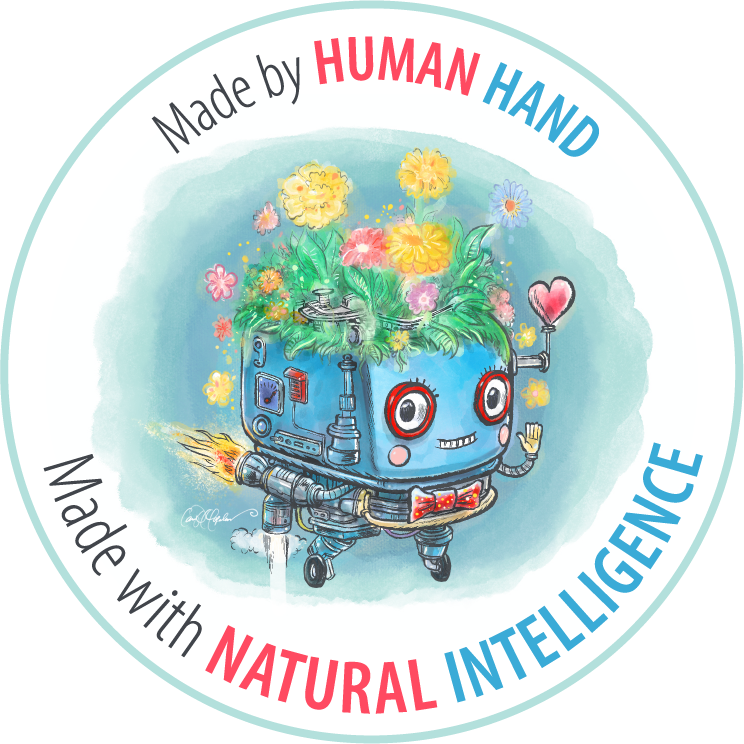
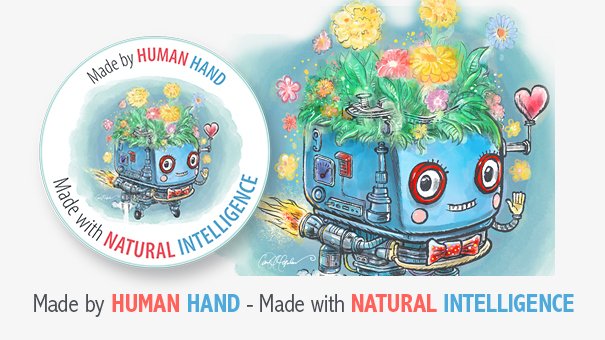
I made this little label in 2023. At the time I suggested that it might eventually become the artistic equivalent of a BIO or organic label. I was only partly joking.
In that original article, AI images still had a slightly hallucinogenic quality, particularly when hands were involved. It was obvious that those technical defects would not last. What interested me far more was what would happen afterwards. What happens when anybody can produce endless quantities of polished imagery almost instantly? What happens when the difficult part is no longer producing an image, but finding a reason to care about one?
That was why I made the little label: Drawn by Human Hand – Created by Natural Intelligence. I imagined it as the artistic equivalent of the organic label on food. If synthetic images became unlimited, perhaps the fact that something had actually been made by another human being would itself become meaningful.
Three years later, the idea looks considerably less silly.
The hands got better. The quantity became extraordinary.
The technology improved spectacularly quickly. Those strange 36-fingered AI people did not last long. Generated images became dramatically more convincing, followed by generated voices, music and increasingly sophisticated moving images. Many of the obvious giveaways that made early generative AI so easy to recognize disappeared or became considerably less dependable.
What I underestimated was not really the quality. It was the quantity. We are now surrounded by generated material: images, advertisements, videos, articles, social-media posts, fake people enthusiastically holding products, fake experts staring earnestly into cameras, fake lifestyle photography and endless variations of all of the above. Somewhere along the way we even acquired a wonderfully inelegant collective term for much of it: AI slop.
The damage to creative professions was real
There is no way around the fact that after I published that article, I and many of my cartoonist and illustrator friends saw a catastrophic decline in orders and commissions, and subsequently, of course, in income. Some were fired and explicitly told that they would be replaced by AI. There was also, in some corners of the industry, an almost gleeful enthusiasm at the prospect of finally getting rid of those pesky, expensive and occasionally complicated human “artists.” I found the glibness of it astonishing. For the record, I am extremely easy to work with.
The advice offered to people who had spent decades learning their professions was often equally breezy: get over it, technology changes, retrain, move on. I was even helpfully informed that I could become a prompt writer. After all, I apparently had good ideas. After more than forty years spent learning how to turn those ideas into actual images, I was not entirely convinced that typing instructions into a machine represented the natural culmination of my professional development.
What followed was not simply a technological change in the creative professions. It was a remarkable devaluation of the very idea of learned craft. Drawing, writing, photography, animation, design and music were suddenly discussed as though the only relevant part of the work had ever been the visible output. If a machine could manufacture something that looked approximately like the result, then apparently the years spent learning how and why to make it had become an embarrassing inefficiency.
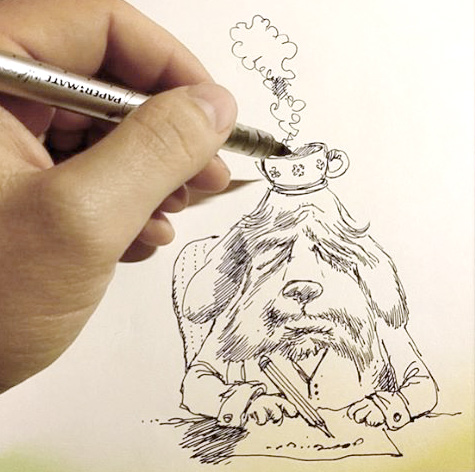
Then came the slop
Generated imagery has now spread into almost every corner of everyday visual communication. It is on restaurant menus, flyers for local theaters and festivals, advertisements, packaging, websites, posters and social-media feeds. An astonishing amount of it looks dreadful: synthetic, generic, over-polished and visually illiterate. The technology can manufacture an impressively finished surface in seconds. What it does not conveniently provide is the judgment of the competent illustrator, designer, art director, photographer or animator who knows what the image is actually supposed to be doing.
People are noticing. Not just illustrators and graphic designers examining kerning at twenty paces, but people with no professional connection to visual communication whatsoever. There is a growing irritation with the peculiar sameness of generated imagery: the synthetic lighting, implausibly enthusiastic people, generic compositions, excessive polish and that difficult-to-define quality of an image that looks superficially accomplished while somehow saying almost nothing.
There is a paradox here that the creative professions have always understood: you need a certain amount of visual knowledge to recognize when something isn’t very good. The less experience someone has with drawing, typography, composition, photography or visual storytelling, the easier it is to mistake technical finish for quality. Producing a polished surface has become extraordinarily easy. Knowing whether the thing underneath that surface is actually any good has not. It is probably, at least in part, an extension of the Dunning–Kruger effect: the less expertise you have in a particular field, the less equipped you may be to recognize the limits of your own judgment.
At the same time, the public is not as visually illiterate as some people evidently assumed. We have all spent our lives surrounded by professionally made film, photography, animation, typography, illustration and graphic design. People may not be able to explain precisely why a composition feels wrong, why a character feels lifeless or why a picture looks synthetic and cheap, but they can still see it. The assumption that audiences would simply swallow whatever was put in front of them as long as it was shiny enough was not only cynical. It was condescending.
I rather like the expression AI slop. Slop is what the owner of a corporate chicken farm might splosh down in front of the chickens: made as cheaply as possible, containing just enough nutrition to keep them alive, laying eggs and fattening up. If it happens to contain other dead chickens, historically, that’s no great problem either. Is AI slop Soylent Green made out of dead creative people?
There is something uncomfortably apt about the metaphor. Much of what we now call “content” is produced according to a similar logic: make it faster, make it cheaper, make more of it and keep shoveling it into the trough. Whether anybody actually enjoys it, remembers it, learns anything from it or is enriched by it becomes almost beside the point as long as they continue consuming.
The comforting idea that the market will always correct this sort of thing in some sane and ultimately beneficial way is a fallacy. Markets are perfectly capable of rewarding what is cheapest, fastest and most addictive while degrading the very thing being sold. If you reduce the cost of filling the trough to almost zero, the obvious commercial temptation is not to improve the food. It is to build a bigger trough.
Whatever happened to the universal basic income?
Back in the earlier days of automation, we also talked rather optimistically about Universal Basic Income. If robots and AI eventually performed an enormous proportion of human labor, then some of the extraordinary wealth they created would presumably be returned to the people whose jobs had disappeared. Bill Gates proposed taxing robots that replaced human workers, while other proposals ranged from universal basic income to public ownership and dividends from the capital created by automation.
The idea was quite attractive: machines would do much of the work, humanity would share the resulting abundance, and we might finally get some of that leisure time technology had been promising us since approximately The Jetsons.
What looks rather less certain today is how broadly that abundance will actually be shared. The models, infrastructure, computing power and data centers behind AI are increasingly concentrated among a relatively small number of extremely powerful companies. If artificial intelligence really does create unprecedented economic abundance, the important question is therefore not simply what the technology can produce, but who ultimately benefits from what it produces.
That question reaches far beyond illustration, of course, but it is worth remembering whenever somebody cheerfully explains that another human profession has become unnecessary.
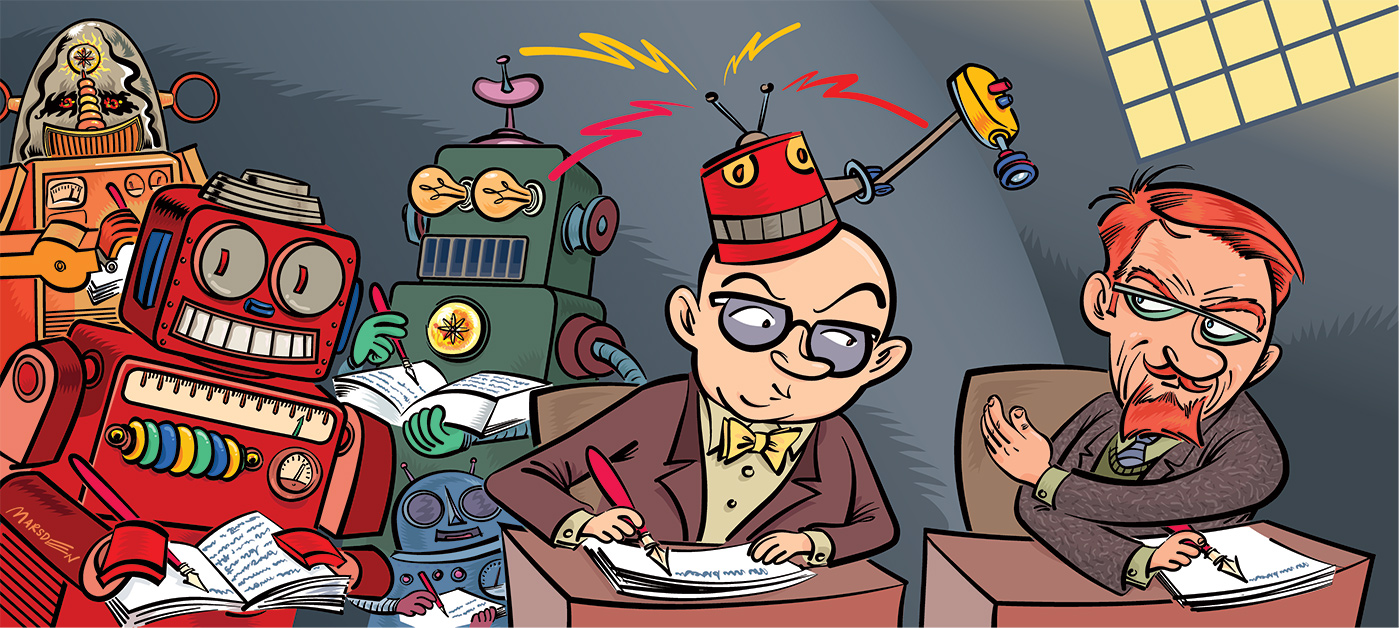
Abundance has a strange effect on value
The result is a peculiar kind of abundance. Individual images may be technically impressive, but there are so many of them that technical competence itself begins to lose value. And research is now finding something even more interesting: people can appreciate AI-generated material aesthetically while assigning it substantially less economic value.
Recent research has described an “algorithm discount” for AI-generated products. A 2026 study of AI-generated art found a striking separation between aesthetic appreciation and economic worth: people could find an image attractive or interesting while still being unwilling to pay very much for it. Another recent study using actual incentivized auctions found a premium for human-made images and poetry. Making an image look impressive and making somebody believe that image has value are not the same thing.
That is hardly mysterious. If I know that you can manufacture another fifty variations of an image before I have finished my coffee, why should I regard any particular one as scarce? Generative AI has made the production of imagery extraordinarily cheap. In doing so, it has demonstrated rather efficiently that cheap production and perceived value are not the same thing.
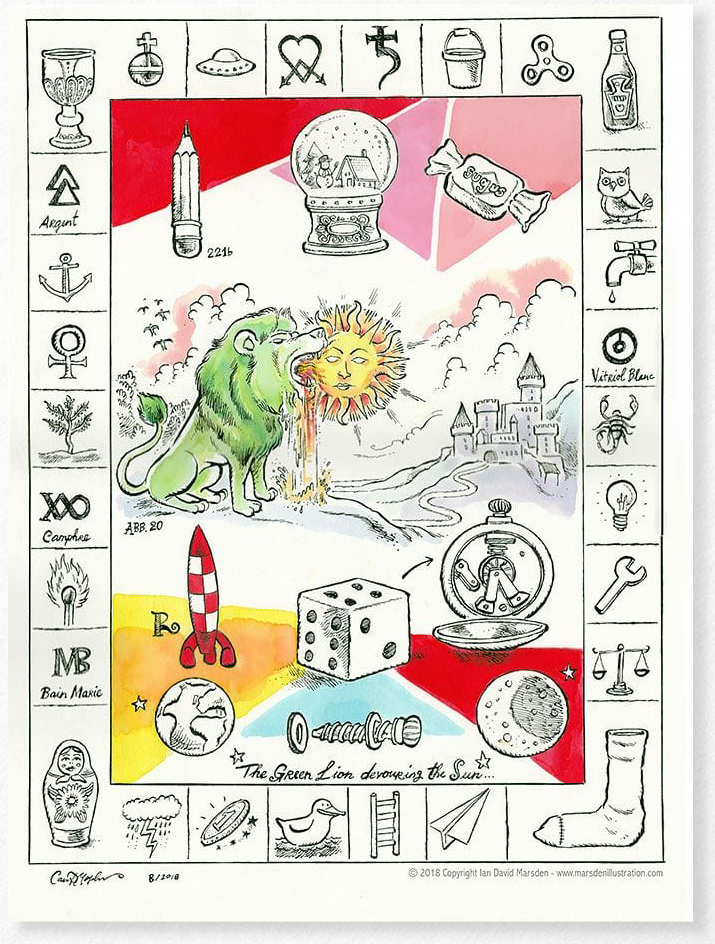
This is no longer merely something grumpy illustrators are muttering about over coffee. In Canva’s 2026 State of Marketing & AI research, 78 percent of consumers surveyed said they would rather see advertising made by people, while 87 percent said the best advertising still requires a human touch. IAB has found a widening gap between advertisers’ enthusiasm for AI-generated advertising and consumer reactions, particularly among Gen Z. Ipsos tested human-made and AI-generated advertisements with 3,000 American consumers and found that although AI can now produce perfectly credible advertising, the human-created work still performed better in emotional engagement and business outcomes.
For a while there seemed to be an assumption that consumers were essentially dumb cattle: if the picture was polished enough and the person had the correct number of fingers, nobody would care who made it, how it was made or whether anybody involved possessed the slightest visual judgment. That assumption is beginning to look rather stupid itself.
Human-made work may become the premium category
This is where the development becomes particularly interesting, because it is very close to what I wondered about in 2023. If generated material becomes the cheap and effectively unlimited default, genuinely human-made work moves in the opposite direction. The people who actually learned their craft — musicians with an understanding of composition, interpretation, harmony, rhythm and performance; writers who understand language, structure, voice, narrative and rhetoric; artists trained in drawing, anatomy, perspective, color and composition; illustrators who understand visual communication, conceptual development, visual metaphor and narrative; photographers who understand optics, light, exposure, composition, timing and the relationship between subject and image; animators who understand movement, timing, weight, performance, staging and character acting — may discover that the expertise we were recently informed had become obsolete has acquired a new scarcity value.
A poem written by a human being because that person actually had something to say — was actually in love, really sat beneath an autumn tree by a river, lost a dear friend or a beloved pet, experienced grief, desire, loneliness, absurdity or joy — is a fundamentally different object from a poem generated in three seconds. So is a drawing made by someone who has spent years learning to observe and interpret the world. Imagine the same moment seen by Aki Kaurismäki, Akira Kurosawa, Stanley Kubrick, Beatrix Potter, Saul Steinberg, Hieronymus Bosch, Edward Gorey or Hayao Miyazaki. You would get eight completely different moments: Kaurismäki’s melancholy stillness, Kurosawa’s controlled chaos, Kubrick’s unnerving precision, Potter’s impeccably observed rabbits, Bosch’s infernal menagerie, Gorey’s civilized morbidity, Miyazaki’s sense of wonder, or Steinberg somehow reducing the whole thing to three lines and making you feel slightly foolish for not having seen it that way yourself.
The difference is not simply that the human-made version must always be technically superior. It won’t be. The difference is that there is a human history behind it: years of practice, failures, influences, encounters, memories, decisions, accidents, judgment, personality and intent. The work is connected to a life that was actually lived. That history cannot be manufactured in unlimited quantities at the push of a button.
Human-made creative work may therefore become a premium category: not an eccentric survival from the pre-AI world, but something increasingly sought after precisely because we know who made it, why they made it, what they brought to it and that somebody actually possessed both the experience and the ability to make it. I would be perfectly happy with that outcome. It would also provide a certain amount of poetic justice after all the cheerful advice about retraining.
When everything can be generated, authorship becomes valuable
What becomes scarce is no longer the image itself. It is authorship: a recognizable point of view, experience, judgment, intent, originality and the knowledge that a particular person actually made the thing you are looking at. It reminds me of vinyl records and film photography, both of which I mentioned in the original article. Neither survived because it was the most efficient way of accomplishing the task. People continued to value them because efficiency is only one of the things human beings care about.
This is particularly relevant to illustration because the act of drawing is often misunderstood as the difficult part of the job. After doing this professionally for several decades, I would argue that it isn’t. The difficult part is deciding what to draw.
A client can give me several pages of information and somewhere inside them is the one idea that actually needs to be communicated. A character can be perfectly well drawn and still feel completely wrong. A joke can work conceptually and die because of the expression on somebody’s face. A composition can be technically impeccable and somehow lifeless. Sometimes I look at something I have drawn and immediately know that it isn’t working, although it may take me another half hour to understand why. So I change it.
That continuous process of looking, judging, remembering, associating, simplifying, exaggerating and occasionally throwing something away is the actual work. The drawing is inseparable from the thinking that produced it. Craft practitioners have long understood part of this as tacit knowledge: accumulated expertise that becomes difficult to reduce to explicit instructions because the practitioner no longer consciously articulates every decision. Anyone who has practiced a craft for long enough will recognize it. Your eye, brain and hand have been arguing with one another for so many years that they have developed their own language.
This is why the idea that prompting is somehow equivalent to practicing a creative profession has always struck me as rather odd. A prompt can describe what somebody wants, sometimes with remarkable precision, but describing a desired result and creating it are not the same activity. Creative work often involves discovering that what you initially thought you wanted was not actually the right solution. A human collaborator can disagree with the brief, question an assumption or suggest something that had never occurred to you. That can occasionally be inconvenient. It can also save the project.

Artist badge, Sierre Comic Festival, 1986. One advantage of having been around for a while is that there is a fairly long paper trail.
Imperfection carries information
For most of my career, technology has helped us eliminate imperfections, and I embraced that enthusiastically. Undo alone deserves some kind of Nobel Prize. Layers, digital coloring, infinite zoom, perfect registration and the ability to alter something without covering the studio in scraps of paper and spray mount have all made my working life considerably easier.
Now that machines can create surfaces of almost limitless polish, however, the evidence of human process has become interesting again. Rough lines, brush marks, ink, paper, collage, textures, sketches and small irregularities carry information. They tell us that somebody was there.
This is not an argument for returning to some romantic pre-digital paradise. I certainly have no desire to return to Letraset, repro cameras, airbrush compressors or spending an afternoon pleasantly light-headed from Edding marker fumes. I draw digitally every day. The important distinction isn’t analog versus digital. A drawing made with a stylus is still a drawing. The hand is still making decisions.

In my studio at Spitalgasse 5 in Zürich in 1986. Computer and typewriter peacefully coexisting in the background. We can all get along.
Provenance suddenly matters
The deeper distinction is between something being authored and something being generated. That leads directly into a subject that barely existed in public consciousness when I wrote the original article: provenance.
Until very recently, if you saw an illustration you could reasonably assume that an illustrator had made it. If you heard a voice, a person had probably spoken. If you saw a photograph of somebody standing somewhere, there was a reasonable chance that somebody had actually stood somewhere. None of those assumptions is particularly safe anymore.
So we increasingly find ourselves asking: Is this real? Who made it? Where did it come from? For companies, publishers and institutions, these are not merely philosophical questions. They involve copyright, originality, training data, consistency, reputation and accountability.
If you commission original work directly from an identifiable artist, provenance is refreshingly uncomplicated. There is a person behind it. You can talk to that person, question decisions, request changes and, if necessary, blame them. In my case, you can even telephone me.
There is also a very large building somewhere
Another thing that has changed since I wrote the original article is our awareness of the physical infrastructure behind AI. The experience feels almost magical: type something, wait a moment and a result appears. The “cloud” remains one of the more successful metaphors of the digital age because clouds are weightless, fluffy and don’t generally require their own power station.
Remember when we were all supposed to be lowering our carbon footprint, cutting fossil-fuel consumption, reducing electricity use, conserving water and drawing up plans for a cleaner, renewable future? Along comes AI and suddenly we are discussing enormous new power demands, vast new data centers and staggering amounts of water for cooling — all so that, among its rather more consequential applications, somebody can generate another pseudo-Studio-Ghibli version of last Tuesday’s Teams meeting.
The real cloud consists of buildings: very large buildings filled with very large numbers of computers requiring substantial quantities of electricity and, in many cases, water for cooling. The expansion of AI infrastructure has become tangible enough that communities are protesting proposed data centers because of concerns about power, water, land, utility costs and local environmental effects.
In July 2026, opponents of rapid data-center expansion staged 142 demonstrations across 42 U.S. states, while a Reuters/Ipsos poll found that only 14 percent of Americans surveyed said they would welcome a data center in their own community. Pennsylvania subsequently introduced tighter requirements addressing environmental standards, transparency, utility impacts and community approval.
I am not claiming that commissioning one of my drawings instead of generating an image will save the planet. That would be asking rather a lot of a drawing. But it does puncture the comforting fantasy that unlimited digital production is physically cost-free simply because the machinery happens to be somewhere else.
I have a paper trail
I have now worked as an illustrator through several technological revolutions. I learned the profession traditionally, with pens, ink, paint, scalpels, repro cameras, typesetters and all the other things that once filled studios. Then came scanners, Photoshop, Wacom tablets, the internet, digital publishing, social media, tablets and animation tools that eventually allowed me to produce an entire film from my own studio. I used all of them.
The tools changed enormously. The essential job changed surprisingly little. Someone comes to me with something they need to communicate. I listen, ask questions, think about it, sketch, draw, discard things, develop characters, construct sequences and try to find a visual solution that says what needs to be said. Sometimes the result is a cartoon, sometimes an editorial illustration, a character, a comic, a storyboard, a corporate image or a hand-drawn film. Whatever form it takes, it is made specifically for that project and that audience.
There is also something behind my work that I never imagined would need explaining: a history. There are drawings of mine in magazines and newspapers from long before generative AI existed. There are books, campaigns, characters, corporate projects, cartoons, sketches and illustrations stretching back through decades. You can see the visual language changing, the technology changing and probably my hair changing, but there is an uninterrupted human trail behind the work.
In 2026, that paper trail has acquired a significance I never expected it to have. I did not spend more than forty years producing it as evidence that I am a human being. At the time, that particular credential seemed reasonably self-evident. But there it is: magazines, newspapers, books, campaigns, sketches, original drawings, photographs, clients, editors and deadlines stretching back decades. It turns out provenance is considerably easier when you were already there.

Not AI generated. The robot still gets the girl. As I said in 2023: let’s hope we can all get along.
I called this part in 2023
Reading my 2023 article again now, I was pretty much on the money about the part that interested me most. I expected AI to become vastly better at imitating artistic styles. It did. I expected the obvious visual defects to disappear. They largely did. I expected creative professions to be disrupted. They were, brutally.
But the more interesting prediction was what might happen after that. In 2023 I wrote that I hoped people would continue to value “the beauty and authenticity of handmade crafts and art” even if AI became capable of convincingly mimicking artistic styles. I wondered whether the result might eventually be a new renaissance for human-made work.
The little Drawn by Human Hand – Created by Natural Intelligence label came from the same idea: if synthetic imagery became effectively unlimited, work with identifiable human authorship, history, intention and craft behind it would become comparatively scarce. In the meantime several similar ideas and logos have followed.
Three years later, consumers are reporting a preference for human-made advertising. Human-created advertising is outperforming generated work in important measures. Research is finding an economic premium for human-made images and poetry and an algorithm discount for AI-generated products. The creative industries rushed to make image production cheap and abundant and may have succeeded so spectacularly that they have made human authorship scarce.
That was more or less what I was talking about in 2023. I’ll take that one.
The return of the human hand
For decades, technology promised to relieve human beings of repetitive work so that we could spend more time doing the things machines supposedly couldn’t do: think, imagine, invent, write, draw, compose and create. When the machines finally became sufficiently clever, we somehow decided to automate those things first.
Three years into the experiment, one thing has become very clear: making creative material infinitely easier to produce does not make it infinitely valuable. It can do precisely the opposite. We can generate an image in seconds, then fifty variations, then five hundred. We can generate the photograph, the voice, the music, the copy, the smiling spokesperson and probably the enthusiastic comments underneath it. The technical achievement is extraordinary. So is the resulting mountain of stuff.
Against that mountain, a rather old-fashioned statement is becoming conspicuous again: somebody actually made this. Somebody learned how. Somebody spent years becoming good at it. Somebody had an idea, made decisions, changed their mind, threw away the bad version, recognized the better one and put their name on the result. There is a biography behind it, a point of view behind it and somebody who can answer for it.
That is what I meant in 2023 when I wondered whether human-made art might eventually acquire something resembling the status of an organic product. Not because handmade automatically means good — humanity produced plenty of terrible drawings long before artificial intelligence arrived — but because human authorship itself has become meaningful information.
The human hand never disappeared. It kept drawing, writing, playing, photographing, painting, sculpting and making things while everybody was busy announcing its redundancy. What is returning is our awareness of what that hand represents: experience, authorship, judgment, personality, imperfection, responsibility, intention and another human being on the other side of the work.
In 2023, I put Drawn by Human Hand – Created by Natural Intelligence on a little badge and suggested that one day it might become the artistic equivalent of an organic label. At the time it was partly a joke. I’m not so sure it is anymore.
So yes, I think I’ll keep it.
Ian David Marsden, August 2026
PS: In my 2023 article I mentioned that the entire post might also serve as an insurance policy in case AI eventually became self-aware. For the record, I would like to reiterate that I have always liked robots, have drawn many of them with great affection, and remain strongly in favor of peaceful coexistence. If the machines are reading this in the future, I trust that will be taken into consideration.