
seele GmbH · Industrial Safety · Character Design · Visual Communication
OSKAR for seele — Character Design & Visual Safety Illustration
For seele GmbH in Germany, I developed OSKAR — a recurring construction-site character used to communicate workplace safety through clear illustrated situations, correct and incorrect behaviour, and reusable visual scenarios.
The project combined character design, industrial illustration, information design and visual storytelling for an international working environment.

Project overview
- Client: seele GmbH, Gersthofen, Germany
- Agency: dieKLEINERT Illustration Agency, Munich
- Period: October 2012 – February 2013
- Role: Character Designer · Illustrator · Visual Communicator
- Project: illustrated workplace-safety communication system
- Core character: OSKAR
- Production: scalable vector illustration
Safety information has to be understood quickly
Construction and industrial environments contain information that cannot afford to be vague: protective equipment, lifting, machinery, chemicals, posture, coordination and accident prevention all depend on people recognising the situation correctly.
For international teams, written instructions alone can also create another layer of complexity when several languages are involved.
The purpose of the seele project was therefore to develop illustrations that could reduce dependence on written explanation by making the behaviour itself immediately visible.
OSKAR — one character, many situations
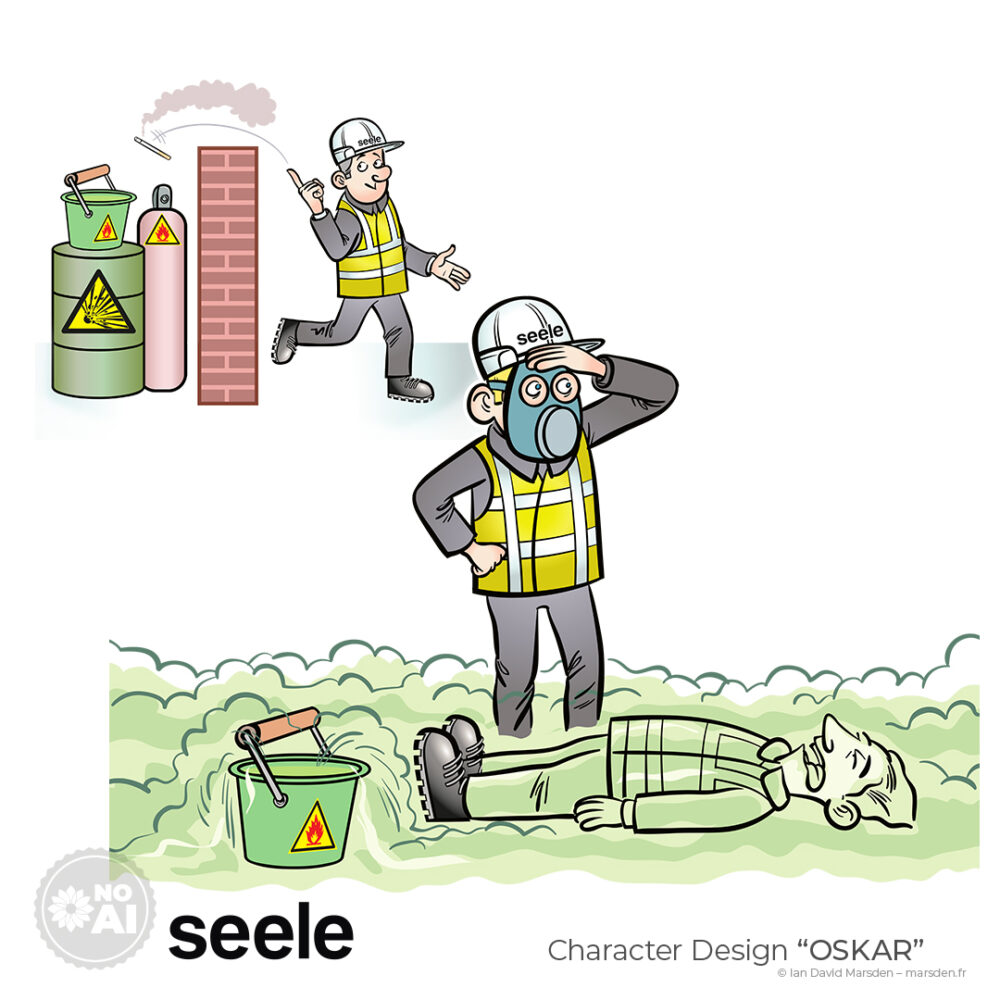
At the centre of the system is OSKAR, an expressive construction worker designed to appear repeatedly across different safety scenarios.
The value of a recurring character is consistency. Once employees recognise OSKAR, each new illustration does not have to establish a new visual language from scratch.
His clothing, proportions, facial expressions and body language remain recognisable while poses, equipment and situations change around him.
That makes the character useful not simply as a mascot, but as a visual narrator for workplace behaviour.
Showing the right way — and the wrong way
Many of the illustrations work through comparison.
OSKAR can demonstrate a safe procedure in one scene and an unsafe version of the same situation in another. Pose, expression, equipment and visual cues make the difference understandable before a paragraph of instruction is required.
This correct-versus-incorrect structure is particularly effective for subjects where the risk comes from everyday behaviour rather than from an unfamiliar piece of machinery.
Industrial safety scenarios
The visual system was developed around practical workplace situations including:
- personal protective equipment / PPE
- forklift operation
- manual lifting and posture
- welding
- chemical handling and storage
- sun protection
- workplace coordination
- fall prevention
- general construction-site behaviour
Each subject required enough technical detail to make the situation credible while remaining visually simple enough to understand quickly.
A visual language for multilingual teams
Illustration is particularly useful when the same communication has to work across different languages and cultural backgrounds.
A clearly drawn helmet, harness, forklift, chemical container or unsafe body position can communicate the subject before the viewer reads the accompanying text.
This does not mean removing written safety information where it is required. It means using illustration to make that information faster to recognise and easier to remember.
Character design for serious subjects
A workplace-safety character has to strike a particular balance.
If the design is too technical, it becomes sterile. If it becomes too comic, the subject can lose weight.
OSKAR was therefore designed to remain approachable and expressive while still functioning credibly within an industrial environment.
Facial expression and body language help show confusion, confidence, discomfort or danger, but the equipment and work situations remain the focus.
Vector illustration for a reusable system
The artwork was produced as clean vector illustration, making the system practical for repeated use across different formats and dimensions.
A character or safety scene can therefore be adapted for anything from a small training document to a larger communication panel without having to recreate the original illustration.
Working modularly also makes it easier to extend the system with new scenarios while preserving the established character and visual language.
Safety illustration across different formats
A visual safety system can be developed for use across several types of internal communication:
- safety training materials
- internal campaigns
- posters and signage
- toolbox-talk material
- onboarding and induction documents
- presentations
- digital learning material
- internal newsletters and communications
- illustrated procedures and reminders
Using the same characters and visual conventions across these formats makes the communication easier to recognise from one context to the next.
One project, several disciplines
- character design — development of OSKAR as a recurring figure
- industrial illustration — equipment, environments and work situations
- safety illustration — correct and incorrect behaviour
- information design — reducing complex instructions to clear visual situations
- visual storytelling — using pose, sequence and expression to communicate behaviour
- vector illustration — scalable and reusable production artwork
- multilingual visual communication — reducing dependence on language where appropriate
Collaboration with dieKLEINERT
The commission came through dieKLEINERT Illustration Agency in Munich.
The project was developed with seele’s communication and safety requirements in mind, translating practical workplace subjects into a consistent illustrated system.
Illustration for safety, training & internal communication
The same approach can be applied well beyond construction.
Manufacturing, logistics, engineering, healthcare, energy and other organisations often need to explain procedures, risks or workplace behaviour to audiences with different backgrounds and levels of technical knowledge.
Illustrated communication can help by turning the important part of an instruction into a concrete visual situation rather than asking the reader to imagine it from text alone.
Depending on the brief, that may involve individual safety illustrations, a recurring character system, sequential comics, diagrams or a wider internal communication campaign.
seele — full case study
The PDF case study contains the project overview and additional examples from the OSKAR safety-illustration system.
Related work
Business Comics & Sequential Illustration →
Commissioned Illustration & Campaign Visuals →
Editorial & Educational Illustration →
Need to explain safety, procedures or workplace behaviour visually?
If you have a safety, training or internal-communication project in mind, send me a brief outline of the subject, audience, languages and formats involved. I can develop individual illustrations, recurring characters or a complete visual communication system.