Sending a Comic Book to Robert Crumb Is Like Sending a Mixtape to Mozart
A Cartoonist, a Postcard, and a Lesson About Steamships
By Ian David Marsden
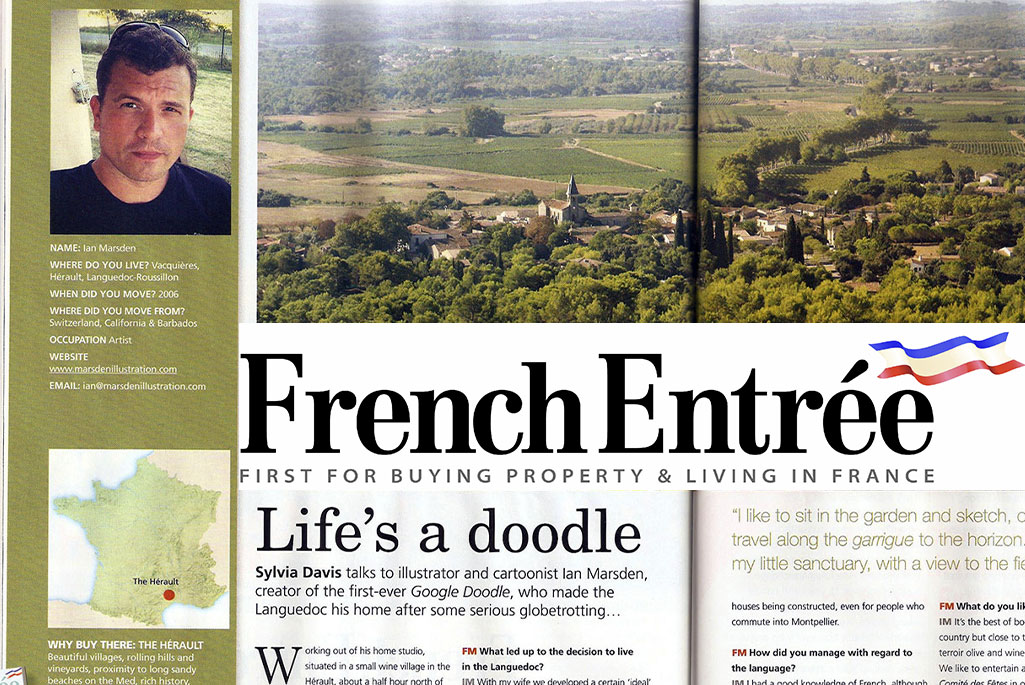
In 2006, I committed an act of transatlantic defection, trading the over-caffeinated bustle of the United States for a tiny, sun-blasted village in the Languedoc region of the South of France — the kind with Roman stones, irregular tavern hours, and eight wineries for every cartoonist.
Very good wineries.
Professionally, I was still doing everything you’ll find on my site or by googling me (and I encourage you to do both, just not at the dinner table). But personally, I had chosen escape: from traffic, from the churn, and from that particular flavor of American overstimulation that turns a simple walk to the post office into a tactical operation.
However, the rural French bush telegraph operates at speeds that defy physics. No sooner had I unpacked my nibs and Bristol board than the local population — farmers, winemakers, and a rotating cast of colorful expatriates — began to circle. Upon learning that the new arrival was an American who drew pictures for a living, a single question began to repeat with the frequency of a skipping record:
“Tiens, vous savez… Crumb habite pas loin.”
“Tu connais Crumb, non?”
Robert Crumb?
That Crumb?
The godfather of underground comix. The man whose pen line vibrates with such uncanny control that even his casual doodles look like finished masterpieces.
It turned out he wasn’t just a legend.
He was a neighbor.
Two villages over.
Celebrity Protocol, Santa Monica Edition
Now, I should clarify my position on celebrity encounters.
Having spent years living in Santa Monica, I was well versed in what might be called the “cool nod” protocol.
You stand behind movie stars at Jamba Juice.
You see rock legends parking next to you at Venice Beach.
You pretend to be fascinated by the nutritional label on your yogurt while a sitcom actor blocks the aisle.
As a native New Yorker, it’s essentially the same rule you learn in Manhattan about the naked guy shouting at you in the subway:
No eye contact.
Except in Los Angeles the naked guy is Matt Damon having a latte with Steve Martin.
In this respect I am a genetic disappointment to my father.
My father viewed celebrity not as a boundary but as an invitation to immediate intimacy. I carry the emotional scar tissue of a dinner circa 1978 in a hushed fine-dining establishment where he spotted Stevie Wonder walking to his table.
While the rest of the room maintained a respectful murmur, my father sprang from his chair like a jack-in-the-box — cutlery flying — with the enthusiasm of a man greeting an old army buddy in a Manchester pub and shouted:
“HEY STEVIE! I LOVE YOU MAN!”
I was twelve. I wanted to dissolve into the carpet.
I vividly remember the security detail pivoting toward us, tense as piano wire, calculating whether to neutralize the threat or simply shield the musical genius from aggressive affection.
To his eternal credit, Stevie — once he realized he wasn’t being assassinated — laughed it off with grace.
My father was full of stories like that. He often told us about the night he was “invited” to hang out with B.B. King and his band in Greenwich Village after a show — an evening of blues and brotherhood that allegedly ended with my father receiving a Courvoisier tab large enough to finance a small military coup.
But then he worked in advertising, a profession built on the elegant blurring of fact and narrative, so one was never entirely sure where reality ended and Madison Avenue copy began.
But I digress.
Writing a Letter to Robert Crumb
Despite the proximity of Robert Crumb, I had no intention of recreating the Stevie Incident in rural France.
I had not crossed the Atlantic to hunt fellow Americans.
And yet…
This was Crumb.
To a cartoonist, encountering Robert Crumb is not simply meeting a colleague. It is brushing up against a foundational text.
I decided that a digital message would be gauche and a phone call too intrusive.
So I chose the gentleman’s approach.
I wrote a short handwritten note.
It was brief, respectful, and cleanly printed — because even for cartoonists there is a proper way to say bonjour.
I may even have included a small drawing, as I often do, though I no longer remember.
What I do remember is that I made one thing absolutely clear:
I had moved to the area by coincidence.
I was not stalking him.
The Return Volley
I dropped the letter into the yellow post box outside our mairie, just across from the village café — did I mention the village looked like a set from the film Chocolat? — and prepared myself for the Sound of Silence.
I had done my duty.
I had been the polite neighbor.
I fully expected my note to vanish quietly into a recycling bin in Sauve, perhaps briefly glanced at by a secretary before disappearing beneath correspondence far more interesting than mine.
I did not expect a reply.
And I certainly did not expect it to arrive with the velocity of a court summons.
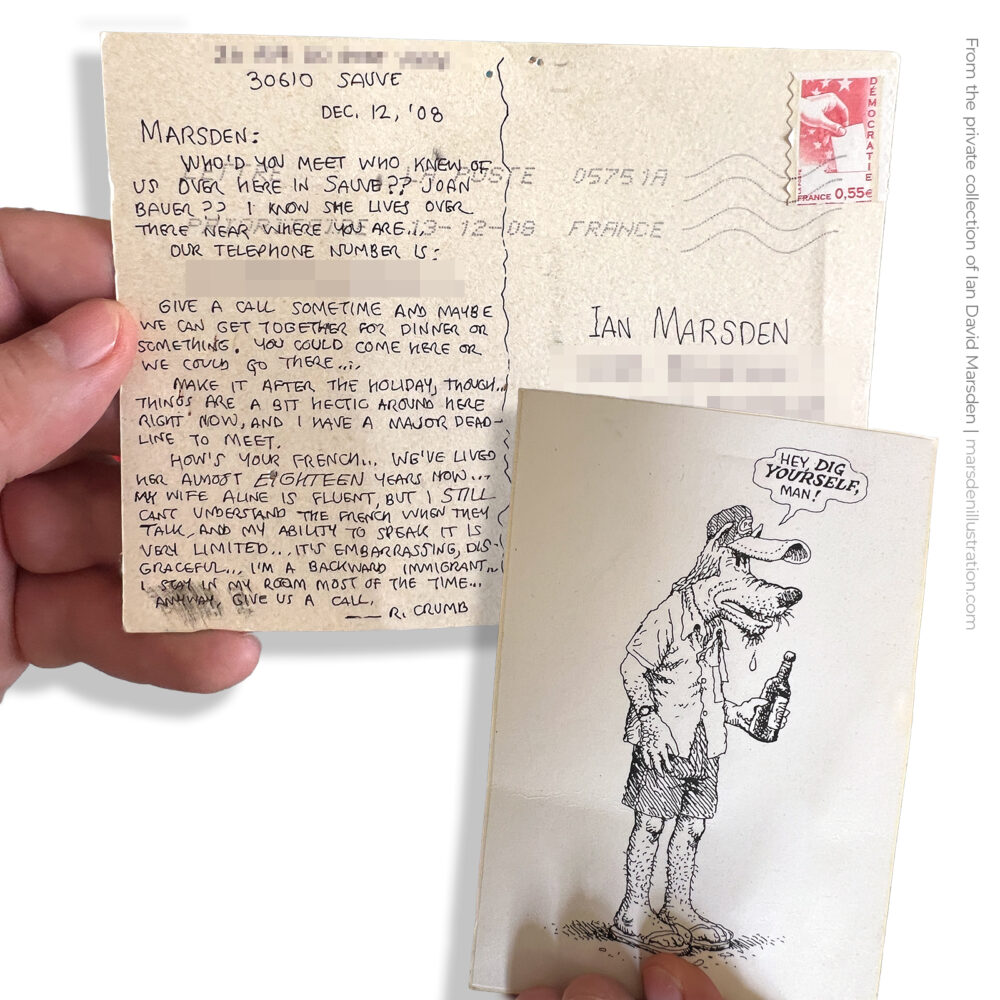
Almost by return post, a postcard appeared in my mailbox.
To understand the gravity of this moment, you must understand the typography.
Most people receive bills, discount flyers, or postcards from relatives featuring sunsets.
I was holding a piece of stiff cardstock featuring a disheveled anthropomorphic dog clutching a bottle and barking the phrase:
“HEY DIG YOURSELF, MAN!”
I turned it over.
The handwriting was unmistakable.
It was The Font.
The nervous, perfectly balanced all-caps lettering that had narrated decades of underground comics was now spelling out my name.
“MARSDEN:” it began.
It was not a cease-and-desist letter.
It was not a restraining order.
It was, bafflingly, a friendly message from a neighbor.
He asked who I knew in the area.
He suggested we meet for dinner.
And then he confessed — wonderfully — that after eighteen years in France his French was still terrible.
“My wife Aline is fluent,” he wrote, “but I still can’t understand the French when they talk… It’s embarrassing… I’m a backward immigrant… I stay in my room most of the time.”
It was disarming.
It was hilarious.
And it was instantly relatable.
The celebrity barrier evaporated.
This was simply a man who happened to draw better than anyone else on earth.
I picked up the phone.
Dinner at the Museum
That first phone call led to a lovely chat and a few laughs as well as a dinner invitation.
The Crumb residence in Sauve felt less like visiting a neighbor and more like stepping into one of his comics.
The townhouse overlooking the river was a curated ecosystem of vinyl records, books, instruments, curiosities, and mysterious objects that seemed to carry entire histories with them.
Exactly as you would hope Robert Crumb’s home would be.
I met Aline Crumb — cartoonist, yoga teacher, and fluent French speaker — whose lively presence perfectly balanced Robert’s self-described “backward immigrant” persona.
We spent the evening talking about art, life, and the strange mechanics of living in rural southern France.
After that, our paths crossed occasionally — sometimes by design, more often by the happy accidents of village life.
Many of those encounters happened at the Vidourle Prix gallery near the bridge into Sauve. Managed by Aline, the gallery had become a magnet for eccentric artists who had somehow drifted to this small corner of the Cévennes.
On certain evenings you could find Robert playing piano or banjo surrounded by musicians who looked so visually perfect they might have stepped directly out of his sketchbooks.
Under normal circumstances I might have suspected hallucination.
However, unlike Crumb, my experience with LSD is entirely nonexistent.
Therefore I was forced to conclude that they were real.
And wonderfully so.
The PEGOT and the Pandemic
Years later, thanks to the tireless work of my literary agent Anna Olswanger — a woman whose determination is matched only by her belief in my potential — I finally landed a publishing contract for my first solo graphic novel.
The subject was Marvin: Based on The Way I Was, a graphic biography of composer Marvin Hamlisch.
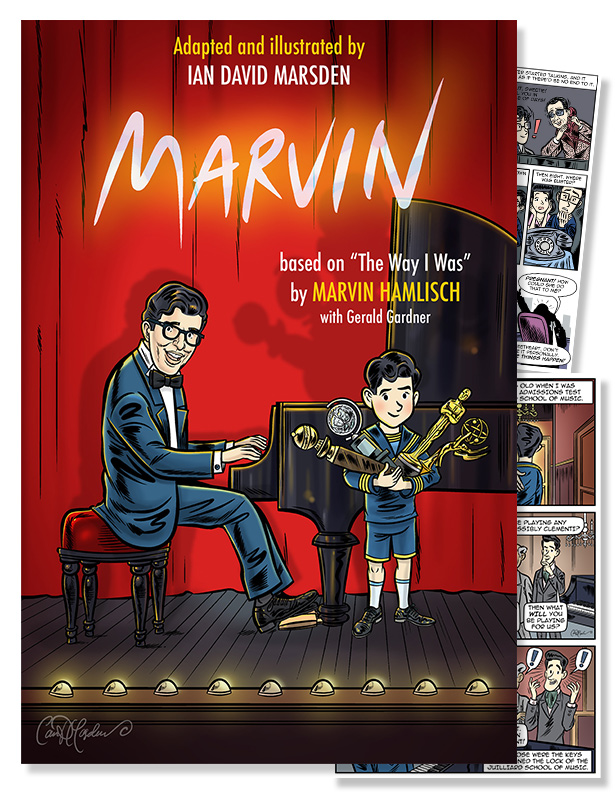
For those unfamiliar with the acronym, Hamlisch was one of only two people in history to achieve the PEGOT:
Pulitzer
Emmy
Grammy
Oscar
Tony
My task was to translate his life story into visual narrative form — from his family’s escape from Nazi-occupied Austria to his acceptance into Juilliard at the age of six and his later career composing for Broadway and film.
It was a labor of love, ink, and caffeine.
The result was a 64-page hardcover published by Schiffer.
The publication date was set.
The presses rolled.
Champagne was chilled.
And then the universe delivered a punchline that was less Woody Allen and more The Book of Revelation.
The year was 2020.
My book was released into a world entering global lockdown.
Bookstores closed.
Libraries shut down.
Literary festivals disappeared overnight.
Marvin launched not with a bang but into a vacuum.
The reviews were generous. The critics were kind. But promoting a biography during a pandemic was a little like trying to sell hearing aids at a mime convention.
So Marvin remains a book mostly discovered by the curious few who stumble across it.
The Critique from the Master
With the world locked down and my book launch echoing into silence, I realized something.
I knew one person who:
A) lived two villages away
B) arguably helped define if not invent the modern graphic novel
So I mailed him a copy.
Sending a comic book to Robert Crumb is a bit like sending a mixtape to Mozart.
It is an act of hubris bordering on insanity.
You are handing your work to the man who helped define the medium and inviting him to inspect your cross-hatching.
I expected silence.
Instead, two days later a heavy parcel landed in my mailbox.
Inside was a beautiful copy of Robert Crumb Sketchbook Vol. 5 with a personal inscription.
But tucked inside was something even better.
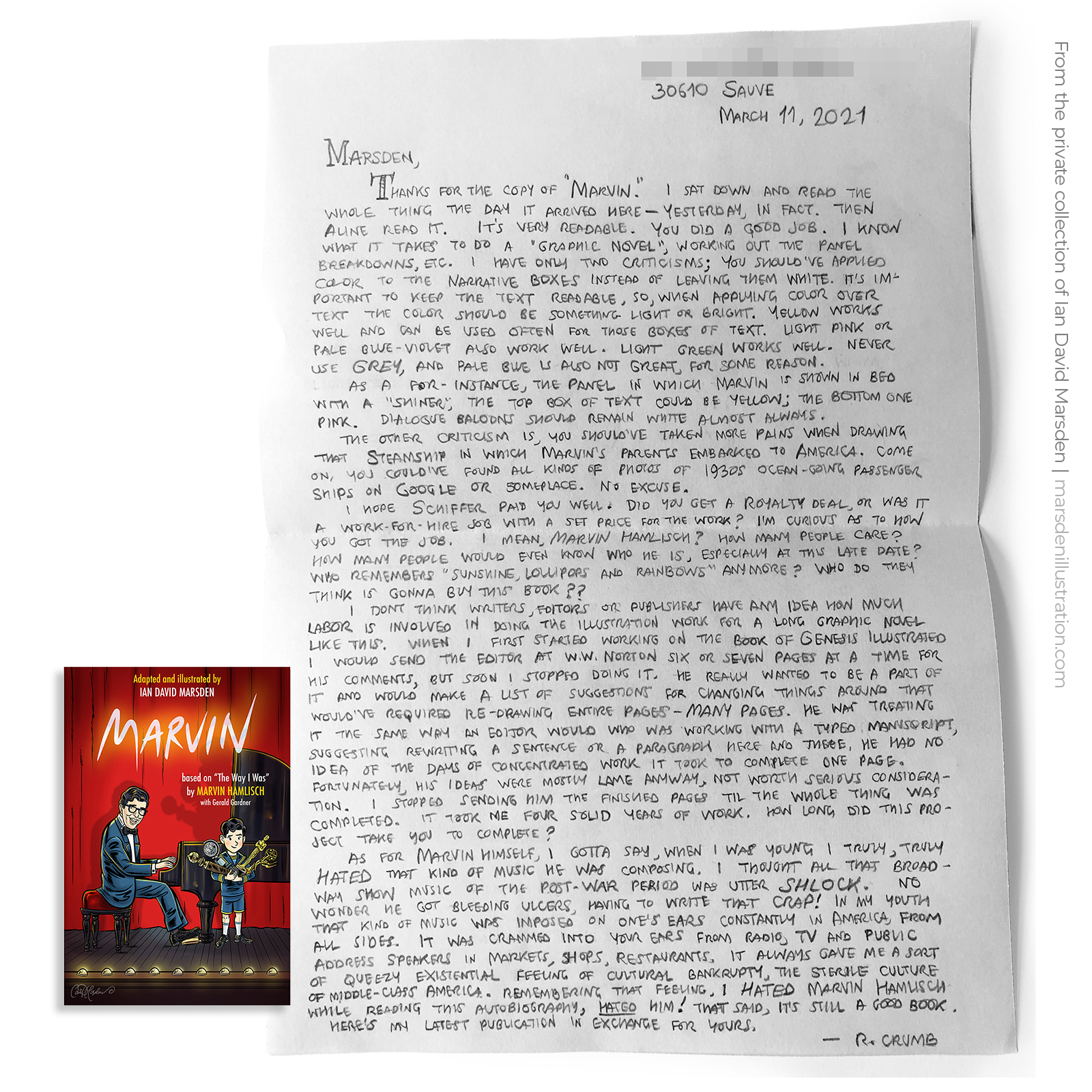
A full-page handwritten letter.
Crumb had read the entire book.
Panel by panel.
He critiqued my color choices.
Questioned my research.
And launched into a gloriously unfiltered rant about Marvin Hamlisch’s music.
It was one of the most entertaining critiques I have ever received.
And it ended with this unforgettable verdict:
“I HATED MARVIN HAMLISCH WHILE READING THIS AUTOBIOGRAPHY…
HATED HIM!
THAT SAID, IT’S STILL A GOOD BOOK.”
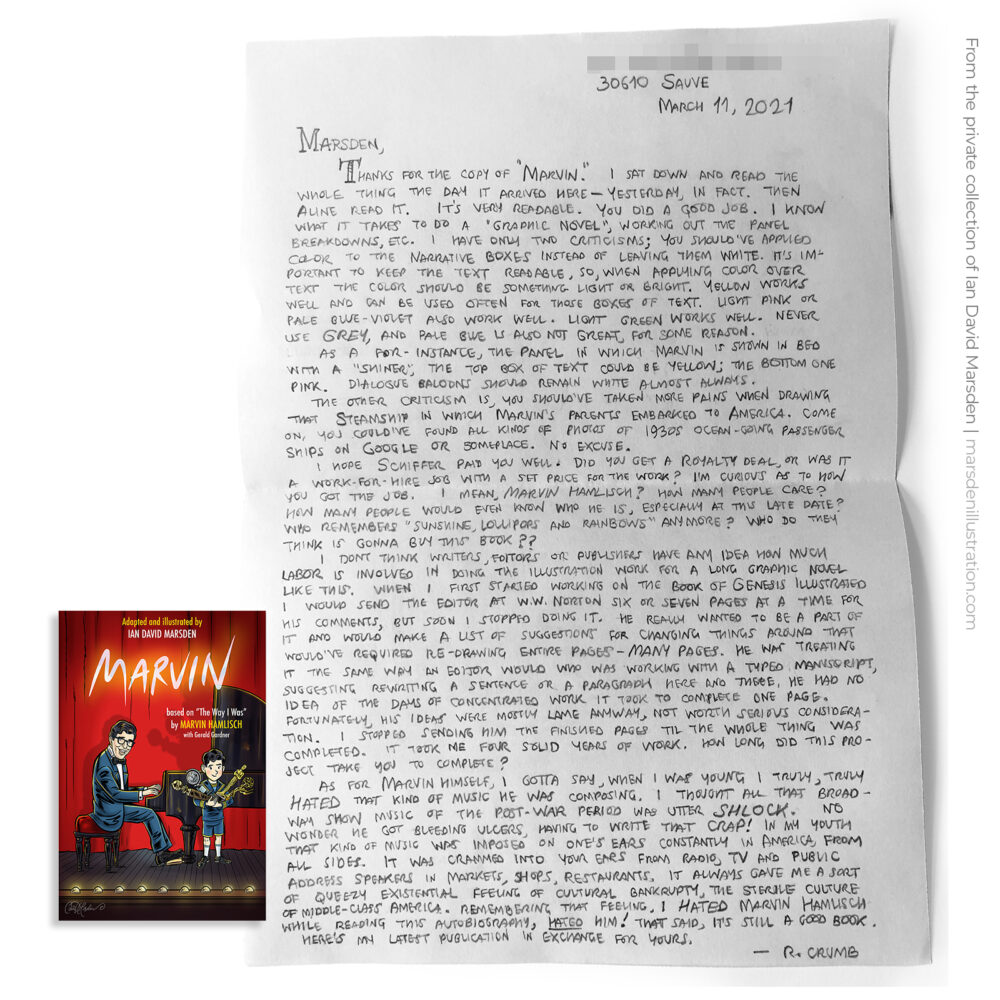
I had just been scolded for my steamship research, lectured on color theory (“NEVER USE GREY”), and told my subject represented the cultural bankruptcy of middle-class America.
And yet…
It was also the best compliment imaginable.
Because if someone who despised the music still read the entire book and respected the storytelling, then something must have worked.
I looked again at my drawing of the steamship carrying Hamlisch’s parents to America.
Crumb was right.
It was a lazy boat.
About the Author
MARVIN: Based on The Way I Was
Graphic novel adaptation and illustrations by Ian David Marsden.
Publisher: Schiffer Publishing
ISBN: 9780764359040
If you happen to own a copy, feel free to send me a photo of yourself reading it. I might include it in my blog.