Cartooning History · New Media · Digital Illustration · 2002
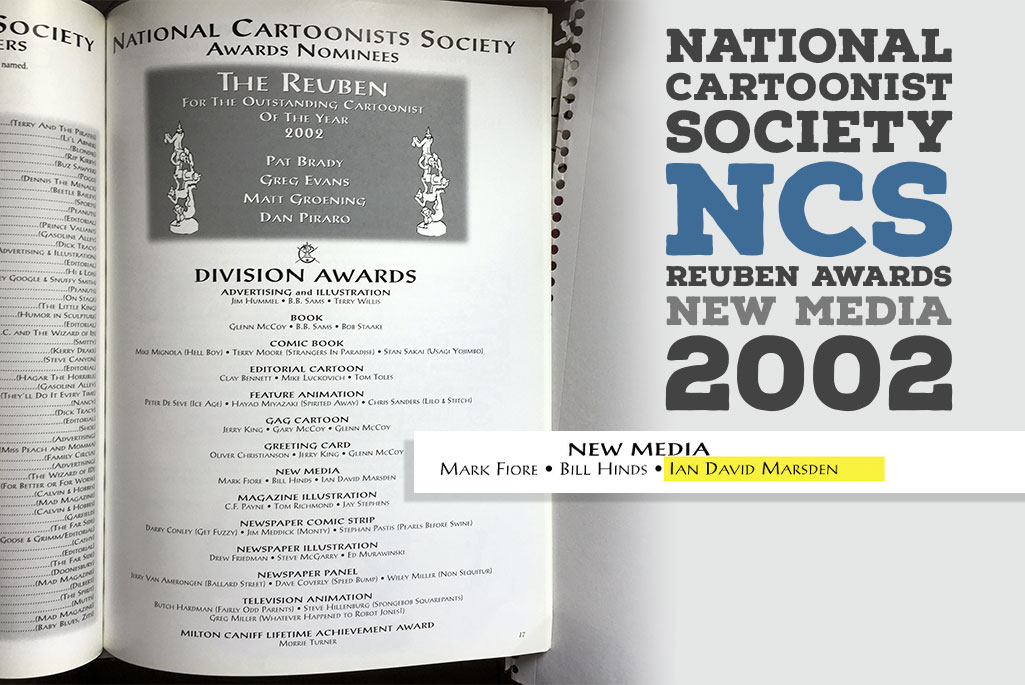
National Cartoonists Society New Media Award Nomination — Reuben Awards 2002
In 2002, the National Cartoonists Society nominated me in its New Media category — at a moment when cartoonists were beginning to explore what drawing, animation and visual storytelling could become on the web.
The nomination belongs to an early digital chapter of my career that included interactive entertainment, online cartooning and my first work for Google.
The Nomination
Cartooning at the beginning of the digital shift
The early 2000s were an unusual period for cartoonists. Newspaper strips, editorial cartoons, magazine illustration and print publishing still defined much of the profession, while the web was opening a very different territory.
Social media, streaming video and app-based content had not yet become normal parts of visual culture. But cartoonists, illustrators and animators were already experimenting with websites, online animation, interactive storytelling, digital editorial work and new forms of character-led entertainment.
The National Cartoonists Society’s New Media category reflected that change. My 2002 nomination recognised work from that early point of contact between traditional cartooning and emerging digital communication.
1999–2001
Sham Records Multimedia and the early online entertainment frontier
A substantial part of my early digital work came through my role as Creative Director at Sham Records Multimedia in Santa Monica. Between 1999 and 2001, we were developing an ambitious online entertainment world built around fictional bands, album covers, characters, animations, interactive spaces and visual storytelling.
This was before the visual language of online identity had settled into the conventions we now take for granted. We were exploring fictional worlds, user pages, music culture, animation, satire, interface graphics and character-led content inside one digital environment.
The project was eventually shelved before release, but the work was an important bridge between my background in cartooning and the possibilities of digital media: building visual worlds, developing characters and using illustration across multiple connected formats.
Google · 2000–2001
The first Google Doodles
During the same period, I began an unexpected collaboration with Google. In April 2000, I illustrated the company’s first official Google Doodle for the April Fool’s Day MentalPlex project.
I went on to become Google’s first official Doodle artist, creating early homepage illustrations including the serialized Alien Abduction sequence and the Olympic kangaroo character for the Sydney Summer Games.
Those images were small, immediate and playful. They were essentially a form of editorial cartooning adapted to the front page of a search engine: a drawing had to communicate in seconds, work at a small scale and bring personality to a technology interface.
Reuben Awards · San Francisco · 2002
A memorable weekend in cartooning
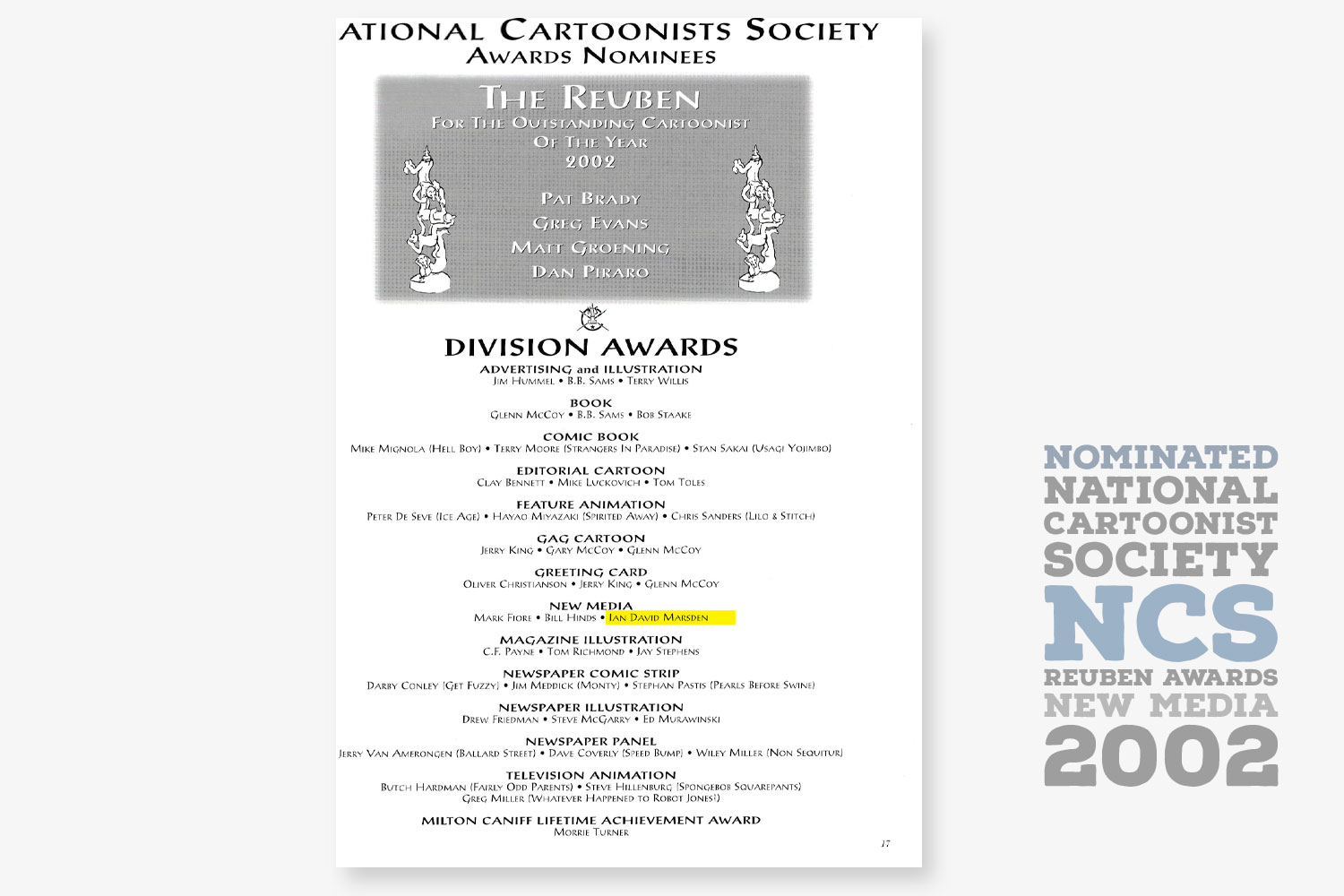
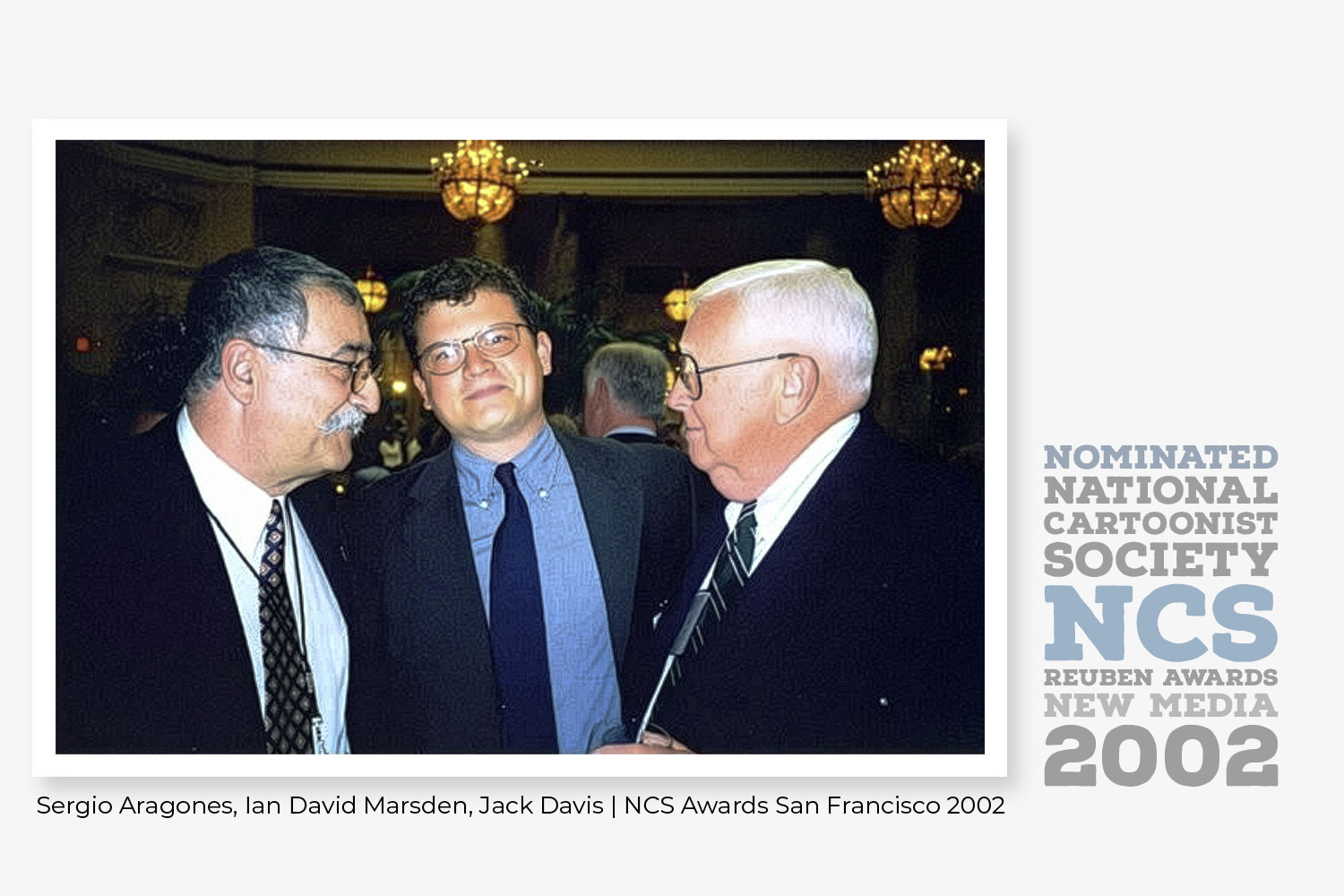
In the New Media category I was listed alongside Mark Fiore and Bill Hinds. The wider Reuben Awards weekend brought together cartoonists, comic artists, illustrators and animators from across the profession.
One connection to the weekend is particularly important to me. Jerry King was the cartoonist who had previously recommended me to Google — a generous introduction that led directly to my early Doodle work.
And then there were the quieter moments. Sitting at the hotel bar with Jack Davis, one of my childhood artist heroes from MAD Magazine, remains one of the highlights I remember most clearly. He was exactly as gracious, funny and generous as one could have hoped.
A Family Memory
The Charles M. Schulz Museum in Santa Rosa
One of my daughter Joanna’s favourite memories from the weekend was our visit to the Charles M. Schulz Museum in Santa Rosa. She was four years old and particularly taken with the recreated studio where Schulz drew Peanuts and the nearby Snoopy’s Home Ice rink.
That part of the weekend has stayed with me because cartooning has never been only a job. It is also a culture of studios, drawing boards, jokes, families, influences, friendships and generations of artists passing enthusiasm and opportunities along.
Looking Back
From New Media to everyday digital communication
More than two decades later, the phrase “New Media” sounds almost historical. The platforms have changed beyond recognition, but the underlying visual problem is familiar: how can drawing make an idea more immediate, understandable and human?
The 2002 nomination marks an early point in that continuing line of work — traditional drawing and cartoon thinking moving into digital environments, long before online illustration, animation and visual storytelling became ordinary parts of communication.
Related work & history
Ian David Marsden & the First Google Doodles →
Comics & Sequential Illustration →
Editorial & Educational Illustration →
Hand-Drawn Explainer Videos →
Case Studies →
Illustration, cartooning & visual storytelling
If you have a project in mind, send me a brief outline of the subject, audience and intended use.